

Systems thinking is a mindset and framework for understanding how elements in a complex whole interact and produce outcomes.
Donella Meadows, a pioneer in this field, defined a system as “an interconnected set of elements that is coherently organized in a way that achieves something”.
In essence, systems thinking means looking beyond individual parts to see the interrelationships and patterns that shape overall behaviorpatterns that shape overall behavior
Table of Contents
Why Is Systems Thinking Important?
In today’s volatile, uncertain, complex, and ambiguous (VUCA) environment, systems thinking is more crucial than ever. In the Harvard Business Review article “Why You Need Systems Thinking Now” (Bansal, T; Birkinshaw, J; 2025) notes that it’s “the best way to anticipate the many secondary effects of change in an interconnected world.”
Instead of linear cause-and-effect, leaders must consider how actions reverberate through a web of connections.
Many innovations that seemed beneficial in isolation have produced unintended consequences when viewed in a larger system.
For example, plastics enabled cheap, convenient products but led to huge pollution problems in terrestrial and marine ecosystems. Similarly, fracking made fuel affordable but harmed water resources.
A systems lens might have foreseen some of these “side effects” by examining how a change in one part of the system (e.g. product design, energy supply, financial risk) influences other parts over time.
As Bansal and Birkinshaw argue, such a holistic approach is essential for sustainable innovation – otherwise today’s solutions can become tomorrow’s problems
The Systems Thinking Mindset
A useful illustration of systems thinking is the “iceberg” model, which looks beyond visible events to deeper patterns and structures.

Christian Tooley explains that focusing only on immediate events means you’re merely reacting. Recognizing patterns and trends means you’re anticipating. Uncovering underlying structures (processes, incentives, infrastructure) means you’re designing better solutions.
Shifting From A Linear Mindset to Systems Thinking
Linear thinking treats cause then effect as a single straight line. Matrix thinking lists factors in tidy boxes as if relationships were fixed
Both help with simple classification, but they miss interdependence, feedback, and delay, so leaders see symptoms and miss the structure that produces them.

Common problems with a linear or matrix lens
- Firefighting cycles. Treating events in isolation drives reactive fixes that do not address the pattern behind them. The World Economic Forum’s systems primer shows why event level focus keeps managers reacting rather than understanding the layers that drive repeat outcomes. World Economic Forum
- Blindness to delays. Early wins can reverse when lagged effects arrive, which makes policies look fine until the feedback hits. The iceberg model highlights how delays sit beneath events and patterns. World Economic Forum
- Missed side effects. Straight line causal stories ignore knock-on consequences across the wider system. HBR stresses that systems thinking is the best way to anticipate secondary effects in an interconnected world. Harvard Business Review
- Suboptimisation. Teams optimise their own box on the matrix and harm the performance of the whole. MIT Sloan links silo fixes to weaker resilience when irregular conditions hit. MIT Sloan
Systems thinking Mindset
Systems thinking asks how elements, relationships, and purpose interact to create recurring behaviour over time.
It examines stocks and flows, feedback loops, delays, and boundary choices to explain why the system performs as it does and where structure can change the pattern. HBR frames this as anticipating secondary effects before they bite.
Benefits when you adopt systems thinking
- Anticipation beats reaction. Looking at structure and feedback reveals second order effects in advance, so leaders are not surprised by ripple impacts. Harvard Business Review
- Deeper diagnosis. Moving from events to patterns to structures to mental models improves explanation and learning. This layered view is central in the WEF primer.
- Better design choices. Accounting for delays and reinforcing or balancing loops reduces oscillation and blame cycles.
- Stronger resilience. A whole-system view surfaces weak signals and hidden dependencies, so organisations adapt before shocks cascade. MIT Sloan documents this advantage in enterprise risk practice. MIT Sloan
- Shared understanding at scale. A common structural map helps diverse decision makers align and coordinate, which WEF highlights as essential in complex environments and post pandemic recovery.
The Shift To System Thinking
- Only focusing on one off events ⇒ reactive management.
- Identifying recurring patterns ⇒ anticipating change.
- Redesigning underlying structures ⇒ designing proactive solutions.
- Shifting underlying mental models ⇒ transformational change.
Business Applications Of Systems Thinking
Systems thinking is not just theoretical; it has tangible payoffs in management.
In operations and risk management, for example, adopting a systemic view greatly improves resilience. However, as MIT Sloan researchers John Carrier and Retsef Levi note, many firms excel in steady-state efficiency but struggle with irregular disruptions because they don’t see the system as a whole – Mit Sloan.
IKEA used to optimise for unit sales and store throughput (see the Ikea Business Model). The newer lens treats each product as part of a larger system that includes design, use, repair, resale, and material recovery. The firm is building roles, rules, and shared services so those stages connect and learn from each other.
What the linear lens looked like for Ikea
- Success meant more new items sold and fast floor turnover. Little visibility once products left the store.
- End of life sat with customers and municipal waste systems. Value leaked as usable furniture was discarded.
- Product changes focused on current range refresh, not on future repair, spare parts, or reuse.
What the systems thinking lens changed
- Life cycle architecture. IKEA’s buy back and resell service lets customers return products for store credit and puts items back into use through As Is sections. It now runs year round in participating markets.
- Market level reuse network. In 2024 Ingka Group began testing IKEA Preowned, a peer to peer marketplace in Madrid and Oslo to grow local reuse beyond stores, with plans to expand.
- Design rules. The Circular Product Design Guide 2024 requires parts that last, can be repaired, and can be offered as spares. In FY24 IKEA distributed 24.6 million assembly parts free of charge and around 190,000 larger spare parts – source IKEA.
- Governance and incentives. Clear terms for buy backs and simple online tools reduce friction for customers and store teams, which scales participation.
Signals That The Shift To Systems Thinking Is Working
he firm reports a smaller climate footprint even as revenues grow, and it is pushing circular services across regions. Independent reporting notes footprint down year on year and down versus 2016, and highlights second hand services and repair as part of the mix. The Wall Street Journal
External coverage and corporate updates through 2024 describe spares availability, circular hubs, and the Preowned pilot as core to the transition rather than side projects.
Why this is a systems move, not a set of add-ons
The boundary expanded from store sales to the whole product life. Interfaces were created between customers, stores, and online exchanges so items can loop back. Rules and incentives align participants so reuse is simple and rewarding. That is a shift from isolated fixes to coordinated structure.
Ecosystems Thinking: Competing Through Collaboration
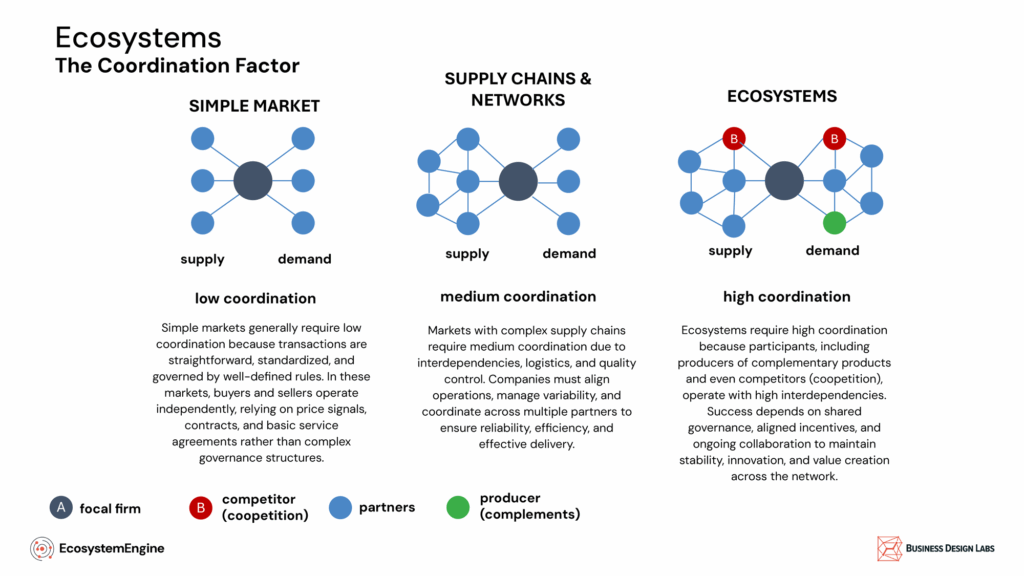
Ecosystem Concept and Definition: In parallel with the need for systems thinking, the last decade has seen a surge of interest in business ecosystems and platform ecosystems as new models for innovation and competitive strategy.
Broadly, a business ecosystem refers to a network of interdependent organizations (partners, suppliers, complementors, customers, etc.) that jointly create and capture value by aligning their activities. Instead of acting as isolated, “insular silos,” firms in an ecosystem collaborate and each play a role in delivering a collective outcome
Michael Jacobides defines a designed ecosystem as
“an orchestrated network spanning multiple sectors. The firms involved work to shared standards, sometimes on a shared platform, to make their products and services compatible. And they create links among themselves that make it difficult for outsiders to break in.”
In other words, an ecosystem has a modular yet integrated structure: participants offer different pieces of a solution, all interoperating through agreed interfaces (technical standards, platforms, or APIs), often under the guidance of a focal orchestrator.
A classic example is Nespresso (see Razor and Blade business model): Nestlé cultivated a network of coffee-machine manufacturers to support its single-use espresso capsules, selecting which partners (Jura, Krups, Braun, etc.) were authorized to make Nespresso-compatible machines and leveraging patents to control the interface.
By designing this coalition of complementors, Nestlé built a protected ecosystem around its product, where each player’s contribution reinforced the value of the whole.

Despite variations in types of ecosystems (business, innovation, platform ecosystems, etc.), all these concepts share “a common focus on the collective production of a coherent system-level output.”
In other words, an ecosystem is geared toward a systemic value proposition – a result achieved only by the combined contributions of different participants, not by any single firm alone. This why the ecosystem concept has proliferated.
For example, in a platform ecosystem (such as those around Apple’s iOS or Google’s Android), a central platform provides a technological foundation or infrastructure on which outside partners can build complementary products.
The platform owner orchestrates the ecosystem by setting rules and standards, while third-party developers, service providers, and even customers participate in value creation.
Such arrangements capitalize on network effects: as more participants join and contribute, the overall ecosystem becomes more valuable, which attracts even more participants.
This dynamic can spur rapid innovation and market expansion, but it also requires careful management of openness, incentives, and integration so that all players benefit.

Why Ecosystems Are on the Rise
Several converging forces in the past 5–10 years have made ecosystem-driven strategy increasingly important. Three major structural shifts enabling the rise of ecosystems:
- Regulatory Rollbacks: In many industries, traditional regulations or barriers that once confined firms to distinct roles have been loosened. This allows organizations from different sectors to partner in serving customer needs in more integrated ways (e.g. banks teaming with tech firms, or accounting firms with legal firms). As these protectionist walls fall, cross-industry collaboration becomes more feasible and attractive.
- Blurred Product-Service Boundaries: Digitalization and policy changes have eroded the old separation between products and services. Offerings are increasingly modular and can be recombined across firm boundarieslondon.edu. Companies now create product-service bundles delivered by networks of suppliers. For example, a “smart home” solution might bundle hardware, software, and services from multiple providers into one coherent user experience.
- Technological Connectivity: Advances in technology (especially mobile devices, cloud platforms, and the internet) revolutionize how firms reach customers and link offerings. Ubiquitous connectivity massively expands the possibilities for integrating once-unrelated products and services. Consumers today expect seamless digital ecosystems – consider how your smartphone ties together apps, devices, and services from countless providers. Technology not only enables these linkages but also amplifies winner-takes-all dynamics in platform markets (due to network effects).
Because of these shifts, single firms increasingly cannot deliver all the components of value that customers demand, nor innovate fast enough alone. Instead, advantage comes from assembling the right constellation of partners. Indeed, competition itself is moving from one company vs. another, to ecosystem vs. ecosystem.
Business strategy is undergoing a “paradigm shift as a result of digital innovation and in particular AI.
s Jacobides observes, “competing is increasingly about identifying new ways to collaborate and connect, rather than simply offering alternative value propositions” in isolationlondon.edu. Executives thus face the challenge of making sense of complex digital ecosystems and finding their role within them.
The old, firm-centric strategic frameworks (e.g. analyzing industries or pure rivals) are less helpful when value is created through interdependent networks spanning multiple sectors. This has led to new ecosystem-focused frameworks intended to guide managers in this landscape.
Strategies for Ecosystem Success
A central question for organizations is how to position themselves in an ecosystem to maximize value.
Should you be the orchestrator (the lead platform or hub around which others gather), or a partner/complementor plugging into someone else’s ecosystem – or both?
Managers to answer this can ask five key strategic questions in the “ecosystem economy”:
- Can we help other firms create value? Successful ecosystems often emerge by one company enabling others to innovate on or alongside its offerings. For example, Nest (now Google Nest) started with a smart thermostat, then broadened its value proposition by allowing third parties to integrate – e.g. a fitness tracker telling the thermostat when you wake up, or a car telling it when you’ll arrive home. By asking how your product can serve as a platform or component for others, you uncover new value that no single firm could deliver alone.
- What role should we play? Not every firm in an ecosystem needs to be the leader. Sometimes it’s better to be a robust complementor or to share orchestration with partners. To be the lead orchestrator, a company typically needs a hard-to-replicate asset (e.g. intellectual property, a large engaged user base, or a strong brand) that gives it leveragepdfcoffee.com. For instance, Apple’s unique combination of patented technology and enormous user reach positions it to dominate ecosystems it enters. Companies must candidly assess whether they have the tools (and the culture) to lead, or whether they thrive best by supporting another platform with their specialized innovation.
- What should the terms be? – This involves ecosystem governance and the “rules of engagement.” How open or closed should the ecosystem architecture be? How will rewards be shared among participants? Striking the right balance is key: opening your platform too widely can invite low-quality complements or “noise,” but too much control can deter partners. Effective ecosystems establish fair rules so that partners have both the ability and the incentives to participate. (For example, Apple allows almost anyone to develop iOS apps but maintains quality control through app review, whereas Google’s Android is more open in architecture but faces more fragmentation.) Clear terms also build trust – partners will only invest if they’re confident the platform won’t expropriate their value (as seen when Rovio built Angry Birds for iOS, trusting that Apple wouldn’t steal its idea, while some earlier open platforms failed due to misuse)
- Can our organization adapt? – Ecosystem participation often requires new capabilities and a mindset shift. Traditional firms used to controlling internal resources must learn to nurture external partners and iterate strategies as the ecosystem evolves. This might mean reorganizing internally to handle external developer relations, or adopting more agile decision-making to respond to changes by complementors. A famous cautionary tale is how MySpace failed under News Corp ownership: its leaders managed it like a traditional top-down media business rather than an open, dynamic network, which allowed Facebook’s more ecosystem-minded approach to eclipse it. Companies need cultural agility, humility, and vision to continuously adjust in a multilateral environment.
- How many ecosystems should we manage? – Finally, firms must decide whether to focus on one ecosystem or participate in several. Some firms concentrate on building one unified ecosystem (e.g. Amazon with its retail, media, and device ecosystem converging via Prime). Others join multiple ecosystems in different roles. Each additional ecosystem engagement can spread resources thin and create strategic conflicts, so companies should weigh the benefits of breadth versus depth. The optimal choice depends on the company’s strengths and the compatibility of the ecosystems in question.
Answering these questions helps firms formulate a coherent ecosystem strategypdfcoffee.com. For example, if your analysis of question 1 shows that your technology could enable many complementary innovations, you might choose to open parts of it to partners (as Amazon did by opening AWS cloud services to third-party developers).
If for question 2 you realize you lack a unique asset to be an orchestrator, you might partner with a larger platform to reach customers (as many fintech startups do by integrating with banking platforms).
These decisions also influence what capabilities you need to develop internally (question 4) and how you govern partnerships (question 3). The overarching lesson is that thriving in an ecosystem economy requires looking beyond your firm’s boundaries.
Just as systems thinking widens a manager’s perspective beyond siloed problems, ecosystem thinking urges strategists to view the business environment as a web of partnerships, platforms, and co-creators.
No company is an island in today’s environment. To drive innovation and business growth, organizations must cultivate alliances and external communities as much as internal assets.
Summary of Systems Thinking and Ecosystem Thinking
Systems thinking and ecosystem strategy are complementary approaches that help firms navigate complexity.
Systems thinking trains leaders to see interdependencies and long-term effects, which is vital for sustainable innovation and avoiding pitfalls.
Ecosystem strategy recognizes that value creation now often spans organizational boundaries, and it provides frameworks for engaging a broader network of partners.
Both perspectives move beyond linear, siloed thinking: one expands the mental map of cause and effect, and the other expands the business model to include collaborators.
We are in an era where solving “gigantic challenges” (and seizing market opportunities) will require multi-stakeholder collaboration and systems thinking at every level.
Companies that leverage these ideas – thinking in systems and competing in ecosystems – are better equipped to innovate wisely, build resilient strategies, and shape the future rather than be blindsided by it.
Key on Systems Thinking and Ecosystems
What is systems thinking?
Systems thinking is a way to understand how parts, relationships, and purpose interact to shape outcomes over time. It looks for patterns rather than single events. It helps you find leverage points where small changes shift the whole.
What is a definition of systems thinking?
Systems thinking is a discipline that explains behavior by mapping structure. It uses stocks, flows, feedback loops, delays, and boundaries to show how causes build and ripple. The aim is to see how structure generates results and where to adjust it.
How do you use systems thinking?
To use systems thinking start by defining the system boundary and its purpose the outcome the system is meant to produce. List the key elements and map their relationships, then add flows of resources, actions, decisions, or information where they exist, and trace feedback loops and delays to explain the pattern of behaviour. Use the map to compare a few structural options, choose the smallest change that improves the pattern, and refine as evidence comes in.
What is an ecosystem in business?
A business ecosystem is set of interdependent actors that co create a system level value proposition. Participants connect through interfaces, standards, data, and rules. Outcomes depend on coordination across many decision makers.
What is ecosystem thinking?
Ecosystem thinking is a strategy lens that designs for creating value beyond the firm. It focuses on incentives, governance, and orchestration to align diverse participants. The aim is to grow value beyond the main firm (orchestrator) and and allow others to generate and capture value.
How does an ecosystem differ from a value chain?
A value chain is a linear sequence of handoffs. An ecosystem is a network of actors that interact in many directions. Control gives way to influence, and success relies on alignment across the network.
What is ecosystem management?
Ecosystem management is the design and governance of a network of interdependent actors that co create a system level value proposition. It sets roles, interfaces, incentives, and rules, manages shared assets such as standards and data, and resolves conflicts so coordination stays efficient. The aim is to grow joint value, sustain ecosystem health, and adapt to change.
References
- Tima Bansal & Julian Birkinshaw, “Why You Need Systems Thinking Now,” Harvard Business Review, Sep–Oct 2025.
- Beth Stackpole, “4 Ways to Boost Enterprise Resilience with Systems Thinking,” MIT Sloan Ideas Made to Matter, Jun 24, 2021.
- Christian Tooley, “What ‘Systems Thinking’ Actually Means – and Why It Matters for Innovation Today,” World Economic Forum, Jan 18, 2021.
- Stefano Oliveri, “These 4 skills can make the world better after COVID-19,” World Economic Forum, Aug 5, 2020.
- Cambridge Institute for Sustainability Leadership, “Demystifying Systems Thinking” (primer), 2021.
- Michael G. Jacobides, “In the Ecosystem Economy, What’s Your Strategy?”, Harvard Business Review, Sep–Oct 2019.
- Michael G. Jacobides, “How to Compete When Industries Digitize and Collide: An Ecosystem Development Framework,” California Management Review 64(3), 2022.
- London Business School, “What Nespresso tells us about the ecosystem economy” (LBS insight by M. Jacobides), Sept 2, 2019.
- Erkko Autio & Llewellyn D.W. Thomas, “Researching ecosystems in innovation contexts,” Innovation & Management Review 19(1), 2022 (open accessr.
- Ron Adner, “Winning the Right Game: How to Disrupt, Defend, and Deliver in a Changing World,” 2021 – concepts discussed in MIT Sloan webinar and book excerpt.
- HBR’s 10 Must Reads on Platforms and Ecosystems, Harvard Business Review Press, 2021 – various articles incl. Eisenmann et al. on two-sided platforms, and case examples of platform governance.


