The circular economy business model focuses on creating closed-loop systems that minimize waste, maximize resource efficiency, and promote sustainable growth.
In recent years, the concept of a circular economy has gained significant traction as a new paradigm for sustainable business practices.
The circular economy business model seeks to move away from the traditional linear “take-make-dispose” approach and instead focuses on creating closed-loop systems that minimize waste, maximize resource efficiency, and foster sustainable growth.
This section will explore the key principles of the circular economy business model, its benefits, impact on business models, implementation strategies, and real-world examples.
Table of Contents
The Circular Business Model
What is the Circular Business Model?
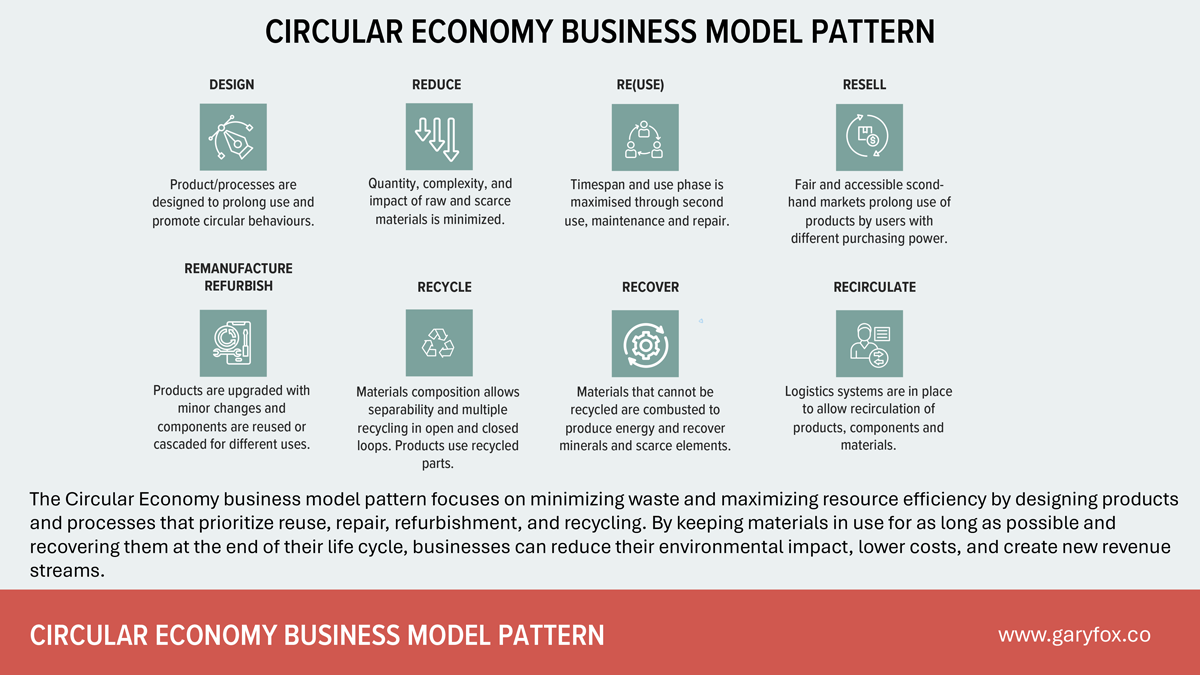
The circular economy business model is based on three core principles:
- Design out waste and pollution: Products and services are designed to eliminate waste and negative environmental impacts from the outset.
- Keep products and materials in use: Products are designed for durability, reuse, and recycling, keeping them in circulation for as long as possible.
- Regenerate natural systems: The model seeks to restore and regenerate natural ecosystems, promoting biodiversity and enhancing the resilience of the natural world.
By adhering to these principles, companies can create more sustainable, resilient, and profitable business models that benefit both the environment and society.
Why is the Circular Business Model Important?
A circular economy business model is vital to reduce how we use valuable resources. Some of the broader benefits include :
- Resource efficiency: By keeping products and materials in use for longer and minimizing waste, you can reduce their dependence on virgin resources and improve their resource efficiency.
- Cost savings: Adopting circular economy practices can help your business reduce costs associated with waste management, raw material procurement, and energy consumption.
- New revenue streams: The circular economy model opens up new opportunities for revenue generation, such as product-as-a-service models, refurbishment and resale, and recycling.
- Enhanced customer loyalty: Customers are increasingly concerned about sustainability and are more likely to support companies that demonstrate a commitment to environmental responsibility.
- Regulatory compliance: As governments around the world introduce new regulations to promote sustainability, firms that adopt circular economy practices will be better positioned to meet these requirements.
How To Implement A Circular Business Model Approach
The circular economy business model requires a holistic and strategic approach:
- Assess current practices: Evaluate your existing products, processes, and supply chains to identify opportunities for circular design and waste reduction.
- Engage stakeholders: Collaborate with suppliers, customers, and other stakeholders to develop a shared vision and roadmap for transitioning to a circular economy model.
- Redesign products and processes: Implement circular design principles, such as using renewable materials, designing for disassembly and recycling, and extending product lifetimes through repair and refurbishment.
- Establish reverse logistics: Develop efficient systems for collecting, sorting, and processing used products and materials to enable reuse, refurbishment, and recycling.
- Explore new business models: Consider adopting product-as-a-service models, leasing, or subscription-based offerings to promote access over ownership and encourage product longevity.
- Measure and communicate progress: Establish key performance indicators to track the environmental and economic impact of circular economy initiatives and communicate these results to stakeholders.
Circular Business Model Examples
Examples of the Circular Economy Business Model Pattern Several firms across various industries have successfully adopted circular economy principles and implemented them:
- Philips: The Dutch technology company has introduced a “lighting as a service” model, where customers pay for the light they use rather than owning the lighting equipment, which Philips maintains and eventually recycles.
- Patagonia: The outdoor clothing company has implemented a “Worn Wear” program, which encourages customers to repair, reuse, and recycle their garments, and offers a trade-in platform for used Patagonia clothing. See Patagonia Business Model
- Renault: The French automaker has established a comprehensive remanufacturing and recycling program for its vehicles, with dedicated facilities for refurbishing and repurposing used parts and materials.
- Interface: The global flooring manufacturer has committed to becoming a fully circular company by 2040, using recycled and bio-based materials, designing products for disassembly and reuse, and offering carpet tile leasing services.
Summary
The circular economy business model pattern represents a fundamental shift in how companies approach production, consumption, and waste management.
By adopting circular design principles, exploring new business models, and collaborating with stakeholders, you can create more sustainable, resilient, and profitable operations that contribute to a thriving economy and a healthier planet.
Related Posts and Business Model Patterns
- Business Model Canvas Examples: Explore 30+ Canvas Models
- Blended Value Business Model
- Orchestrator Business Model
- Types Of Ecosystems – What Defines Each And What You Need To Know
- Microfinance Business Model