AI maturity levels helps organizations to improve how they implement AI. AI adoption requires more than deploying new tools.
Companies that thrive with AI transform how they think, operate, and make decisions across every function. Yet repeatedly my engagements with clients reveal a repeated pattern of fragmented initiatives and a lack of integration across the layers of the organization.
The solution doesn’t lie in understanding AI – often there are some good talent in pockets across the organization – it is more fundamental than that. There simply isn’t an over arching strategy and plan.
Most executives say they’re leading their organizations into the future. AI is being piloted, teams are being reskilled.
- In a 2024 Deloitte survey, 74 percent of executives listed operational efficiency or cost reduction as their primary AI objective. Source Deloitte.
- McKinsey found similar patterns: the top AI use cases are service operations (24 percent), product optimization (20 percent), and contact center automation (17 percent). source: McKinsey & Company (2023). The State of AI in 2023: Generative AI’s Breakout Year.
- But, Bain & Company says it bluntly blunt in its 2023 analysis: most AI deployments are “narrow in scope and tied to legacy workflows”. Source: Bain & Company (2023). AI Trends Briefing: The Emerging Enterprise Playbook.
- Moreover, Gartner Predicts Over 40% of Agentic AI Projects Will Be Canceled by End of 2027 – why – lack of alignment with strategic goals.
But beneath the surface, a more familiar pattern is unfolding.
The AI maturity levels grid I have developed is useful tool to help align senior teams on what core enablers and capabilities are needed to accelerate AI adoption and deployment.
I’ve also developed a similar tool for AI governance.
Table of Contents
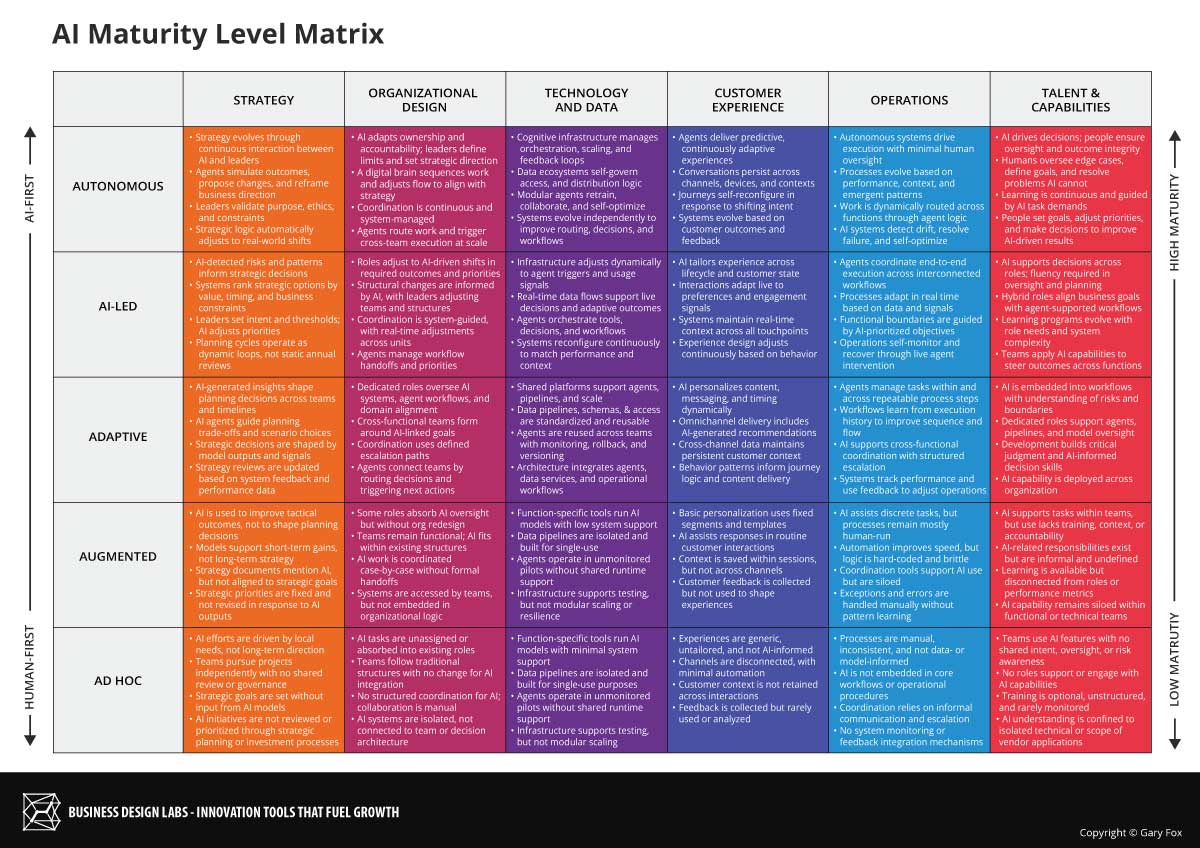
The AI Maturity Level Matrix
What are AI Maturity Levels?
AI maturity levels measure how well an organization has restructured its systems, roles, and processes to work effectively with AI. The level of maturity reflects how well capabilities and enablers are aligned to an organization. AI maturity levels arent concerned with how many and what AI tools are deployed or the sophistication of individual projects.
What are the Dimensions of the AI Maturity Levels?
The AI maturity levels consist of six critical organizational dimensions: Strategy, Organizational Design, Operations, Technology and Data, Customer Experience, and Talent and Capabilities. These categories must develop together because weakness in one area creates bottlenecks that limit AI effectiveness across the entire organization.
What are the Stages of AI Maturity Model?
The AI maturity model contains five progressive levels: Ad Hoc (inconsistent experimentation), Augmented (AI supports specific tasks), Adaptive (AI embedded in workflows), AI Led (AI systems drive execution), and Autonomous (AI operates across domains with minimal intervention). Each stage builds the foundational readiness required for the next level, and organizations cannot skip stages without creating systemic weaknesses.
How to Assess AI Maturity Levels in an Organization?
Assessing AI maturityn levels begins by selecting one organizational category and evaluating the current state against each maturity level using observable evidence rather than future plans. Leaders gather specific examples of how AI is actually being used, then repeat this process across all six categories to identify misalignments and friction points.
What are the Benefits of High AI Maturity Levels?
Organizations with high AI maturity levels have AI systems, human roles, and business processes working together seamlessly to drive better decisions and outcomes. This alignment results in a sustained competitive advantage because mature AI capabilities become embedded in the organization’s operating model rather than as isolated experiments.
What is an AI Maturity Self Assessment Tool?
An AI maturity self assessment tool provides a structured framework that helps leadership teams evaluate their organization’s readiness across all dimensions affected by AI transformation. The tool guides strategic planning by revealing where capabilities are misaligned, where investment should be prioritized, and how different organizational functions need to evolve together to support AI driven operations.
A Aerospace OEM’s Transformation
The Problem: A global OEM in the aerospace had invested heavily in AI across multiple departments but saw limited measurable business impact after a years of effort. The executive team wanted to understand what was causing the bottlnecks and why there were some projects that failed, some that were stalling and only a few that were managing to scale.
What Was Happening: A pattern emerged from interviews across the divisions and their AI projects: initiatives were fragmented, knowledge remained siloed, and talent was consistently underused.
More critically, there was no shared understanding among teams or leaders about the organization’s overall AI capabilities, either at the enterprise level or within divisions.
Some departments had more advanced methods, greater access to resources, and deeper AI talent, while others lagged significantly. In the absence of a unifying structure or framework, knowledge remained fragmented and cross-learning was minimal.
The Solution: I held a workshop with the leadership team and the management team across five divisions.
We charted the AI maturity levels then mapped to a set of actions using the AI maturity radar below.

The Impact: One big takeaway for me was this: when they focused on fixing gaps in structure and skills instead of chasing more technology, the divisions actually started hitting their AI goals within six months. What made the difference was forming real cross-divisional relationships, sharing what worked, and creating more collaborative ways of working and knowledge sharing.
The Hidden Structure of AI Success
Most organizations are focused on improving operations
Most discussions about AI focus on algorithms, data quality, or technical infrastructure. These elements matter, but they represent only one dimension of organizational readiness.
True AI maturity requires coordinated development across strategy, organizational design, operations, technology and data, customer experience, and talent capabilities.
Consider how AI affects strategic planning. At basic levels, organizations treat AI as a separate initiative with dedicated budgets and isolated goals.
However, at mature levels, AI shapes every major business decision, from capital allocation to market entry strategies. The difference is not just about the level of technological sophistication but how you organize for integration.
The same pattern emerges across business functions. In operations, mature organizations redesign workflows around AI capabilities rather than layering AI onto existing processes.
In talent development, they create new roles and learning pathways that help people to work alongside intelligent systems. In customer experience, they use AI not just to drive down costs or scale volume, but to fundamentally reimagine the customer experience
The Five Stages of AI Organizational Development
AI maturity follows a predictable progression through five distinct stages. Organizations cannot skip levels without creating systemic weaknesses that limit their ability to capture AI value.
Ad Hoc organizations use AI inconsistently across departments. Projects emerge based on individual initiative rather than strategic coordination. Results vary widely, and there is little organizational learning or capability transfer.
Augmented organizations deploy AI to support specific tasks or functions. AI remains siloed within departments, with limited integration or governance. Success depends on local champions rather than systematic capability.
Adaptive organizations embed AI into workflows and support these systems with appropriate roles, learning programs, and infrastructure. Collaboration increases, and people develop shared understanding of how AI affects their work.
AI Led organizations enable AI systems to drive execution while humans focus on oversight and intervention. AI influences decisions, workflows, and performance metrics across multiple functions. The organization operates differently because of AI.
Autonomous organizations allow AI to operate across domains with minimal intervention. Human roles concentrate on oversight, exception handling, and outcome definition. The organization has been fundamentally restructured around AI capabilities.
Each stage builds essential readiness for the next level. Organizations that attempt to jump from Ad Hoc experimentation to AI Led operations inevitably encounter failures because they lack the foundational capabilities required for success.
The Six Dimensions of AI Organizational Readiness
AI transformation affects every aspect of organizational design and operation. The six dimensions provide a comprehensive view of where AI creates change and where capabilities must develop together.
Strategy measures how AI influences goal setting, planning, and investment decisions. Organizations progress from treating AI as a separate initiative to embedding AI considerations in every major business decision, from capital allocation to market entry strategies.
Organizational Design tracks how roles, teams, and structures adapt to support AI operations. This includes creating new positions, restructuring reporting relationships, and developing governance frameworks that enable AI systems to operate effectively within existing hierarchies.
Operations assesses how AI changes task execution, coordination, and escalation processes. Advanced organizations redesign workflows around AI capabilities rather than simply layering AI tools onto existing processes, enabling seamless integration between human and machine decision making.
Technology and Data examines the infrastructure, data flow, and systems architecture needed to support scalable AI deployment. This encompasses everything from data accessibility and quality to system integration and real time processing capabilities.
Customer Experience captures how AI reshapes interactions, personalization, and service delivery. Organizations move from using AI for basic automation to fundamentally reimagining how they create and deliver value to customers through intelligent systems.
Talent and Capabilities evaluates how skills, learning, and role expectations evolve as AI becomes more central to operations. This includes developing new competencies, creating learning pathways, and preparing people to work effectively alongside intelligent systems.
Assessing Your Organization’s AI Readiness
Effective AI maturity assessment requires systematic evaluation across all six organizational dimensions. The process begins by examining one category in detail, using observable evidence rather than aspirational planning.
Start with the dimension most critical to your current strategy. If customer experience drives competitive advantage, begin there. If operational efficiency is paramount, start with operations. Gather specific examples of how AI currently functions in that area, then compare these examples against each maturity level.
The key is evidence over intention. Organizations often overestimate their maturity because they confuse planned initiatives with actual capability. Mature assessment focuses on what is happening today, not what leaders hope to achieve tomorrow.
Once you complete assessment in one category, repeat the process across all dimensions. This reveals critical misalignments where strength in one area cannot compensate for weakness in another. For example, advanced technology capabilities mean little if organizational design and talent development lag behind.
Organizations with high AI maturity achieve what others cannot. They transform isolated initiatives into a cohesive system where technology, talent, and processes operate in concert. This is not just coordination. It is integration. AI maturity turns the organization into an ecosystem.
An organizational ecosystem creates sustained strategic advantage because AI is not bolted onto existing structures. It is embedded into the operating model. Intelligence becomes part of execution. Learning becomes continuous. Strategy becomes responsive.
The benefits extend well beyond operational efficiency:
- Mature organizations make consistently better decisions by combining human judgment with AI insights through structured, repeatable processes.
- They adapt faster to market shifts because their systems detect weak signals early and their teams are equipped to act decisively.
- They innovate more effectively by using AI infrastructure to test ideas at speed, iterate quickly, and scale what works.
The most critical advantage is structural. While less mature firms burn time and capital on disconnected pilots, mature organizations invest in compounding capabilities. Each initiative reinforces the next. They avoid the cycle of false starts, missed expectations, and narrow wins that characterizes AI failure.
Building Your Maturity Assessment Practice
Creating an effective AI maturity assessment requires careful preparation and systematic execution. The process works best as a collaborative effort that brings together perspectives from across your organization.
Workshop Setup and Requirements
Successful assessment workshops include representatives from strategy, operations, technology, human resources, customer experience, and finance functions. Each perspective contributes essential insights about how AI affects their domain and how different capabilities connect.
Plan for a half day workshop with senior decision makers who can speak authoritatively about their functions. Prepare by gathering current AI project inventories, technology infrastructure assessments, role descriptions for AI affected positions, customer experience metrics, and recent strategic planning documents.
Schedule the session when participants can focus completely on the assessment without competing priorities. Assign someone to facilitate cross functional discussions who can maintain neutrality rather than advocating for specific outcomes.
Implementation Process
The assessment follows ten systematic steps that build comprehensive understanding of your organization’s AI readiness:
Step 1: Select Starting Category. Choose the organizational dimension most critical to your current AI strategy or where gaps might create the greatest business risk.
Step 2: Gather Evidence. Collect specific examples of how AI currently operates in that category, focusing on actual behaviors rather than planned initiatives or pilot projects.
Step 3: Assess Current Level. Compare your evidence against each maturity level description to identify where your organization currently functions most consistently.
Step 4: Document Findings. Record your assessment with supporting examples and note areas where evaluation proved difficult or where evidence was contradictory.
Step 5: Repeat Across Categories. Complete the same rigorous assessment process for all six organizational dimensions to build a complete maturity profile.
Step 6: Identify Misalignments. Compare maturity levels across categories to discover where limitations in one area create bottlenecks that prevent progress in others.
Step 7: Prioritize Gaps. Focus on foundational weaknesses that affect multiple categories rather than attempting to advance simultaneously across all dimensions.
Step 8: Develop Action Plans. Create specific initiatives to address priority gaps, with clear ownership assignments and realistic timelines for each development area.
Step 9: Engage Stakeholders. Share findings with relevant teams throughout your organization, using concrete examples to build shared understanding of what maturity progression requires.
Step 10: Schedule Review Cycles. Establish quarterly or biannual reassessment processes to track progress and adjust priorities as your organization’s AI capabilities continue evolving.
Moving from Assessment to Transformation
The AI Maturity Matrix serves as more than an assessment tool. It provides a strategic framework for coordinating transformation efforts across your entire organization. Use it to identify where investment will create the greatest impact, where capabilities need development before others can advance, and how different functions must evolve together.
Remember that the goal is not reaching the highest maturity level in every category. The goal is building the right level of capability to support your organization’s AI ambitions while maintaining alignment across all dimensions.
Organizations that master this systematic approach transform AI from an experimental cost center into a strategic advantage. They coordinate their development efforts, avoid costly misalignments, and build capabilities that compound over time. In an economy increasingly shaped by AI, this organizational maturity may prove to be the most important competitive advantage of all.
The OEM company mentioned earlier in this article now uses the maturity framework to guide their AI transformation. Six months after their initial assessment, they report better coordination between departments, clearer investment priorities, and measurable progress toward their AI goals. More importantly, they have a shared language and systematic approach for the challenging work that lies ahead.
Your organization’s AI future depends not on the sophistication of your technology, but on the maturity of your approach to transformation. The framework exists. The question is whether you will use it.


