
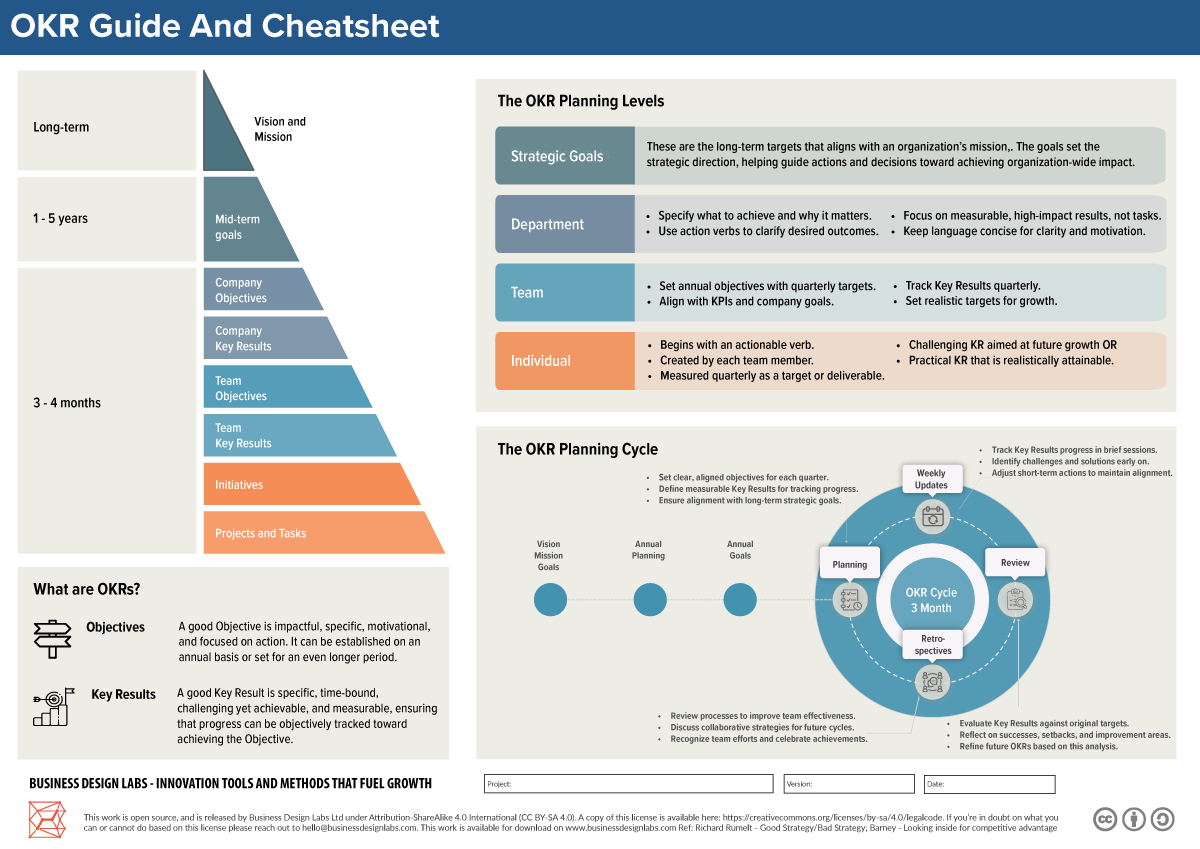
I’ve put together a structured OKR guide to help overcome the pitfalls and common mistakes that many companies hit – usually after their first attempt at implementing them.
First of all, let’s take a brief overview of why they are important and how they came about.
When aligning strategy with execution, many organisations rely on familiar frameworks like KPIs or SMART goals. However, there are problems with these methods.
Often, priorities get lost, and teams don’t focus on what matters most, especially when priorities rapidly shift.
This is where OKRs (Objectives and Key Results) come in. They offer a structured way to bridge to align strategic objectives with clear, prioritised actions.
By defining clear objectives and measurable key results, OKRs ensure that each goal supports the organisation’s broader strategy.
This approach gives leaders a practical tool to break down large, ambitious goals into achievable steps. It shifts the focus from routine tasks to outcomes that drive progress.
OKRs also bring a level of transparency that many other systems lack. When goals and results are shared across teams, accountability increases, and alignment becomes easier. This visibility empowers everyone to understand not just what they are doing, but why it matters to the overall mission.
For leaders, adopting OKRs means creating a culture where strategic goals are clearly communicated, progress is regularly tracked, and teams are motivated to exceed expectations.
OKR Guide
OKR Guide Menu
- OKR Guide – Introduction
- What Is An OKR – A Practical Explanation
- OKR Framework – Key Points for Leaders
- OKRs vs KPIs – Understanding the Key Differences
- How To Write An OKR – A Practical Guide
- Strategy and OKRs – From Mission To Implementation
- OKR Examples – From 10 Different Industries
- The Best OKR Software – Pros and Cons of Each
- OKR Templates – Free Templates To Start Now
- OKR Summary – Essential Points To Maximize Results
History and Background To OKR’s

The concept of OKRs (Objectives and Key Results) can be traced back to Silicon Valley in the 1970s.
John Doerr popularized OKRs after learning the framework from Andy Grove, who was then the CEO of Intel. Grove, often hailed as one of the great minds in tech, saw OKRs as a way to boost clarity, focus, and accountability across Intel.
He saw them as a way to transform ambitious goals into concrete, measurable steps.
Andy Grove and How OKR’s Came About
Grove first adapted OKRs from Peter Drucker’s “Management by Objectives” (MBO), but unlike the MBO approach, which focused more on setting objectives, OKRs emphasised the pairing of each objective with measurable results.
Grove insisted on quantifiable results for every objective. In his view, setting a goal without a measurable outcome was ineffective.
Intel famously pivoted from memory chips into microprocessors-one of the boldest moves that would secure its future. OKRs played an essential role in this, keeping Intel teams on target and responsible for each other through the turbulent times.
Grove famously summarized the spirit of OKRs in one line: “Only the paranoid survive,” epitomizing his belief in constant vigilance, adaptability, and execution.
John Doerr Spreads The Idea of OKRs
In the late 1970s, a young John Doerr joined Intel as a new sales engineer. Soon enough, he was taken under the wing of Grove and learned about OKRs from the very source.
By the time Doerr had left and joined the venture capital firm Kleiner Perkins as a partner, he introduced OKRs to his portfolio companies including Google in 1999. Google’s founders Larry Page and Sergey Brin were skeptical.
But he explained to them that OKRs could organise its explosive growth without stifling innovation. This was quickly imbedded in the DNA of the company as Google adopted OKRs.
At Google, everyone from engineer to executive sets OKRs every quarter. The OKRs were public inside the organization, so progress and accountability were shared commitments.
OKRs have since been credited as part of the critical frameworks that helped Google through that alignment as it grew from a small startup to a global powerhouse.
When OKRs proved successful at Google, other tech giants such as LinkedIn, Twitter, and Uber followed suit, adopting OKRs as an orderly, flexible way to pursue audacious goals.
Doerr did not stop there; he went ahead to publish a book called Measure What Matters in 2018, which cemented OKRs as a mainstream goal-setting tool.
Despite the simplicity of OKRs, they require a culture of transparency and purpose-driven leadership to make them effective.
Why Use This OKR Guide?
Now you know the background to OKR’s. What’s important though is how to know how they work, how to implement them and also to avoid the hard and soft mistakes.
Hard mistakes are basically not setting the right objectives and outcomes. While, soft mistakes are the cultural considerations that are important to consider.
In this guide to OKRs (Objectives and Key Results), I’ll provide a comprehensive roadmap for leaders and teams to set, align, and achieve goals to support their broader purpose and mission.
Here’s an overview of the OKR guide covered to help readers understand what they’ll gain:
- Introduction to OKRs
The OKR guide starts by explaining what OKRs are and why they matter. The guide contains real-world examples to help you learn how OKRs focus efforts, foster accountability, and help organisations achieve ambitious goals by breaking them into measurable steps. - Key Components: Objectives and Key Results
Another section of the OKR guide explores the anatomy of OKRs – Objectives define what the organisation aims to accomplish, while Key Results outline how success will be measured. The OKR guide gives you specific examples to demonstrate how well-defined OKRs align daily tasks with a long-term strategy. - Role of Leadership and Management in OKRs
This section of the OKR guide shows how you to articulate your vision using OKRs and focus on priorities. Leaders set high-level objectives, and managers guide teams in practical execution, ensuring every team member understands and aligns with the organisation’s mission. - Implementing OKRs for Goal Achievement
The OKR guide also contains case studies (e.g., Google, Duolingo), to illustrate how OKRs can be used to transform large missions into achievable milestones. You will gain insights into how OKRs can turn a vision into action by focusing on disciplined execution, tracking progress, and adapting them along the way. - Distinguishing OKRs from Other Metrics
There is often some confusion prevent confusion about how OKRs differ from KPIs, project plans, and business-as-usual tasks. In this OKR guide I’ll give you how they differ and how they can complement each other. - Writing Effective OKRs
A hands-on section of the guide provides the OKR templates to help you in crafting Objectives and Key Results that are clear, actionable, and measurable. This part focuses on creating meaningful outcomes rather than listing tasks. I’ll provide with that show you how to frame impactful OKRs. - Tracking and Adjusting OKRs
OKRs are not static. In this section of the OKR guide I’ll discuss how regular check-ins are needed to track progress and make adjustments. Structured tracking and frequent reviews will keep your teams aligned, and offer early signs of success or highlight areas that need correction. - Common Pitfalls and Best Practices
Readers are alerted to common mistakes in setting OKRs, such as confusing them with activities or setting unambitious goals. Best practices include setting “stretch goals” that encourage growth, fostering a proactive approach to continuous improvement.
Some Initial Guidance On Using OKRs
Some companies avoid the typical cycle of rapid action followed by excessive bureaucracy by adopting Objectives and Key Results (OKR) processes.
OKRs aim to clarify goals and set expectations proactively. However, despite good intentions, the implementation often falls short.
Many companies struggle with OKR practices, leaving managers feeling burdened by administration and employees subject to unpredictable directives from leaders. Managing performance effectively is a significant challenge for startups.
A key issue in implementing a solid performance management program is that individuals and organizations often view the concept too narrowly. To set a better foundation, let’s broaden our understanding: performance management encompasses a variety of activities, policies, and practices designed to help employees enhance their performance.
These initiatives start with performance appraisals and extend to feedback, goal setting, training, and rewards. Thus, performance management begins with appraisal as a starting point, then moves towards improving individual performance in line with strategic goals to enhance overall firm performance.
Many leaders feel overwhelmed at the prospect of building a complete performance management program. Some even lack formal HR training. Fortunately, some straightforward practices can help align employees with company goals and address performance issues constructively.
Effective performance management typically relies on three core elements: clarity, feedback, and consequences. When these are applied effectively, they strengthen manager-employee relationships, enhance trust, and minimize unnecessary administrative work. Ultimately, employees are supported and developed, helping the organization retain valuable talent.
Clarity involves communicating a focused list of reasonable expectations. High-growth companies though often struggle with clarity, as the fast pace can make it challenging to maintain focus.
However, without prioritizing critical activities, organizations risk getting bogged down by competing initiatives. As Karen Martin, author of The Outstanding Organization, says, “when everything is a priority, nothing is a priority.”
Another challenge to clarity in startups is the rapid pace of change, which complicates goal setting compared to more stable environments. To set meaningful goals, leaders need to create clear objectives at the organizational, team, and individual levels, balancing ambition with realistic timelines.
Performance management goes beyond deciding who gets promoted, who stays, or who is let go. It guides the entire workforce toward better performance. Rather than discussing goals at a single meeting and leaving them for an annual review, goals need regular, detailed communication with teams and individuals.
Managers should hold consistent one-on-ones with each employee to discuss goals and progress, acknowledging each employee’s unique context. These one-on-ones serve as the foundation for communication in growing startups, providing valuable opportunities for course corrections and addressing performance issues as they arise.
Many companies use OKRs as a framework for goal setting, often setting them at the company, department, and individual levels on a quarterly basis. OKRs are typically measured by scoring each goal’s progress, often targeting around 70 percent to encourage stretch goals.
While I support clearly defined goals (objectives) and specific metrics for tracking them (key results), many growing companies misuse OKRs and might benefit from alternative goal-setting practices.
OKRs work best when supported by quantitative data, but this can be difficult to capture meaningfully in startups where work is often complex and team-based. Consequently, OKRs may lead to convenient but often arbitrary measures of success, such as completion dates or quality indicators.
Moreover, setting a target of achieving 70 percent of a goal can create unintended consequences, such as encouraging “sandbagging” during goal-setting or fostering a culture that tolerates underachievement.
For most companies, I recommend setting goals that function as firm commitments rather than aspirational targets. This approach can streamline performance management, making goals more straightforward and fostering accountability across the organization.
An OKR Guide

The Next Section of The OKR Guide
Need Help With OKRs?
OKR Rollout Program – A 12-Month Plan
This program addresses a key challenge faced by CEOs: executing strategy effectively. The OKR Implementation Program helps organizations bridge the gap between strategic intent and outcomes by deploying the right OKR framework to drive focused execution across the organization.
OKR Coach
With an OKR Coach, your company gains the knowledge of the Agile leadership method, Objectives and Key Results (OKR). This workshop is ideal for agile coaches, directors, and executives seeking to understand and apply this framework effectively to drive impactful outcomes, accelerating the organization’s path to success.
OKR Strategy Sessions
This an online set of session (3 * 3 hours), that provides a hands-on OKR way to design your strategy and align your OKRs. This is ideal for CEOs, executives, operations managers, and direct managers. By using a proven OKR system, this session enhances team alignment with company goals, enables precise performance measurement, provides actionable feedback, and drives improved results.


