In this section of the business model, I’ll show you the different types of partner relationships, how to decide what partners to choose and what to consider – the common mistakes that people make.
Table of Contents
What Are Key Partnerships?
A business partnership is when companies (commercial entities) form an alliance, which is either exclusive or loose. Loose relationships mean that both parties can still partner with further entities, whilst exclusivity limits to either company to that that one relationship.
Most partnership relationships are for the simple reason that most businesses want to have a spread of other businesses to reduce risk and provide opportunities for growth.
When considering key partnerships there are several factors that need to be considered.
- Link to Value Proposition.
- Selection criteria.
- Partnership agreements.
- Defining terms and service levels.
- Development of a win-win relationship.
1. Value Proposition and Key Partnerships
The key partnerships building block refers to the commercial companies that help to deliver the overall value proposition. These companies can supply needed infrastructure, services, materials, parts, products and so on. They are instrumental in helping you develop your overall business model.
One way of viewing partners is they can be outsourced suppliers of key activities and resources that you need but are not core to your business.
Another factor for consideration is fluctuations in demand. As an example, if you are in the business of producing events you might hire sound equipment rather than purchase it.
The reason for this is that you have a fluctuating demand for it and there are plenty of suppliers.
Key partnerships provide a huge variety of ways to create value and it is often a combination of partners that makes an organization unique.
2. Selection Criteria for Key Partnerships
The goal when choosing partners is to optimize value. Traditionally, the focus has been to drive down costs by sourcing more flexible solutions from partners for activities that are non-core.
However, quality and not price are a key factor when deciding which partner – your brand and business can be severely damaged if a poorly chosen supplier doesn’t provide consistent service levels or products to the quality you need.
Selection criteria help you to create a checklist in simple terms of the most important factors for selection. There are hard and soft factors. Hard factors are the specifications of the service or products.
However, often an overlooked but equally important factor is the soft factors.
Soft factors are related to how well two businesses can work together. Some of the soft factors for partner relationships are:
- the similarity of the cultures.
- vision and values of the two companies.
- ambitions and attitudes.
In a nutshell, if the people are at polar opposites of culture and values then the partnership is more than likely to be bumpy or even fail.
3. Key Partnerships and Agreements
Both parties need to agree to different factors that have operational, intellectual and financial implications. The first stage is to define the elements of the partnerships and then define how they will affect each partner.
Of course, as discussions progress and the details are clarified, legal conditions have to be considered and agreed upon as well.
4. Defining Terms and Service Levels
Terms set out intentions in a clearly and concisely. The terms of an agreement comprise of financial, legal, operational and administrative aspects. In addition, there needs to be a summary fo the interactions and exchanges.
This enables all parties to focus on the important matters without having to go through the exhaustive details within the overall document. Service levels are the minimum delivery level required.
As an example, a web hosting service might commit to 99.5% uptime.
5. Developing A Win-Win Partnership
There are always areas for negotiation especially for high-value contracts involving complex services. However, if when entering negotiations you aim to not compromise or work towards some common ground then you are entering a win-lose agreement. Whilst, you might feel as though you have won, often suppliers then look to cut corners to make up for difficult to meet agreement conditions and margins.
A much better way of operating is to aim for win-win agreements.
Business Model Key Partnerships
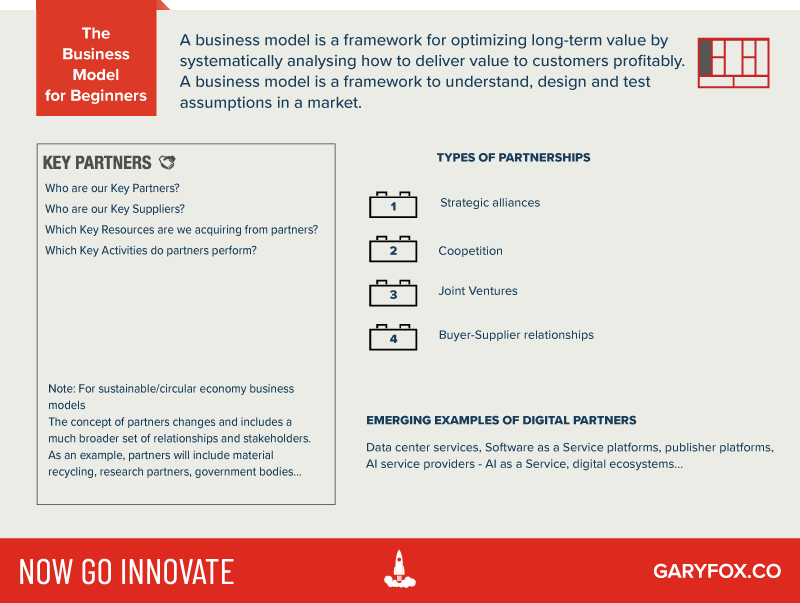

Connecting Activities to Key Partnerships
Key partnerships are external relationships that reinforce your business model by expanding reach, reducing costs, or accelerating access to capabilities.
These may include strategic alliances, supplier agreements, licensing arrangements, or co-development deals.
Each type of partnership serves a distinct purpose depending on your strategic priorities. Effective partnerships allow you to focus on your core strengths while leveraging others for speed, scale, or specialized expertise. The most valuable partnerships are not transactional.
They are built for mutual benefit, long-term alignment, and the ability to respond to shifts in market conditions or operational needs.
What to Consider When Defining Key Partnerships:
- Strategic Role
Clarify whether the partner helps you scale operations, enter new markets, reduce exposure to risk, or accelerate delivery. - Complementary Strengths
Select partners who offer capabilities, technologies, or access that you cannot develop efficiently on your own. - Operational Dependency
Assess how critical the partner is to your performance and what risks arise if the partnership is disrupted. - Aligned Interests
Structure the partnership so both sides benefit proportionally. Misaligned incentives weaken commitment and trust over time. - Build versus Partner Decision
Evaluate whether it is more effective to outsource or co-develop a function rather than building it internally. - Cultural Fit
Ensure shared values, compatible decision processes, and open communication to avoid costly misalignment. - Governance and Accountability
Define clear roles, responsibilities, ownership of outcomes, and mechanisms for conflict resolution. - Capacity to Grow
Choose partners who can evolve with your business as customer needs, market conditions, or technologies change.
Considerations for Key Partnerships
Some further considerations for key partnerships:
- Optimization – efficiencies and scale.
- Reduction of risk and uncertainty.
- Outsourced activities and resources.
1. Optimization
For these types of key partnerships, the goal is to identify and partner with companies that provide low-cost solutions because of their scale. As an example, many companies including Spotify use Google Cloud. Soem of the reasons for this are:
- cheaper than buying, running and owning web servers.
- Google Cloud can easily scale as a business grows.
- Google Cloud infrastructure is global.
2. Reduction of Risk and Uncertainty
By jointly working together partners can reduce investment risks and uncertainty. Often this is the case with highly technical research and development programmes.
3. Outsourced Activities and Resources
When areas of expertise can be sourced through partner companies it is often more beneficial to outsource to them rather than hiring teams of people. This leaves a company able to focus on its core activities that fit to the value proposition.
Types of Key Partnerships
There are different types of key partnership that could be useful to your business, such as:
- Buyer-Supplier partnership: This is the most common form and it could help you to have a reliable and systematic source of supplies for your business.
- Co-opetition: Partnering with another company producing the same thing to gain more market share, reduce risks and create synergies.
- Strategic Alliance: this kind of partnership is formed between non-competitors.
- Joint Venture: Partnering with a complementary company to produce a new product.
Key Questions
- What if we found a partner who could manufacture core resources for cheaper than we can do it ourselves?
- Who else could stock our products?
- What other services could benefit from integrating what we do?
- How can we use our spare capacity to solve problems for other companies?
- Whose brand could we leverage to build our credibility?
- What services will other businesses require in the future that don’t exist today?
Examples of Partnerships
- Volvo partners with Harmon Kardon for the sound systems in their cars.
- Apple partners with Cisco.
Red Bull and GoPro. GoPro sells more than portable cameras, while Red Bull sells more than energy drinks. They are both lifestyle brands that have similar goals. This illustrates how they both overlap in terms of audience and brand. They have the following in common:
- Fearless
- Adventurous
- Extreme
- Action-packed
Spotify partnered with Uber because they both had the same goal of getting more users even though they had different products. Uber riders can pick out a Spotify playlist to choose what they’ll listen to during their ride. This helps both Spotify and Uber fans have a better experience during their ride in the car.
NEXT SECTION
In the next section, Cost Structure I’ll take you through how to understand the key cost levers for your business model.