
In this article, I’ll explain the principles of a strategic arena and how they apply to ecosystems. It represents a fundamental shift in how firms approach opportunities and competition.
In 2019, McKinsey analysts studying Tesla faced a puzzle. The company’s stock valuation exceeded Ford and General Motors combined, despite producing fewer vehicles than either competitor manufactured in a single quarter. Traditional automotive metrics suggested massive overvaluation and industry experts predicted imminent collapse.
They missed something fundamental. Tesla never competed in the automobile industry. Elon Musk positioned Tesla in the sustainable energy arena, encompassing transportation, home energy storage, solar generation, and charging infrastructure. While Ford and GM optimized manufacturing efficiency, Tesla captured an entirely different value proposition across multiple traditional industries.
This shift in competitive thinking, from industries to what strategists term “arenas,” explains why some companies achieve extraordinary success and valuations, while others struggle within conventional markets competing for marginal market gains.
A strategic arena focuses on how to redefine the game itself rather than playing by existing rules.
Table of Contents
What Is a Strategic Arena?
Strategic arenas represent the actual battlegrounds where companies compete for customer resources, attention, and loyalty, unlike industries, which group companies by similar products or services, arenas group competitors by the customer jobs they aim to capture.

1. Deconstructing The New Competitive Arena
The principles of strategy are undergoing a seismic shift.
For decades, strategic management has been anchored in the concept of the industry as the primary unit of analysis.
Traditional management frameworks were created at a time when the world was a relatively stable sector with predictable competitive dynamics. This era is over. Digital technologies have radically changed customer behaviours and needs, the economy and how organisations are structured and the nature of work.
The result is that value is no longer created in discrete industry sectors, but across sectors and competitive domains. To understand how and where to compete, we need to shift our thinking to “competitive arenas” and “business ecosystems”.
The Obsolete Traditional Industry Analysis
Firms now compete within interconnected business ecosystems, where industries compete with one another, and the boundaries between strategy, innovation, and entrepreneurship have become increasingly blurred. This transformation has made conventional industry analysis and its assumption of stable competitors irrelevant.
The Competitive Arena: The New Battlefield
The broadest and most useful macro-level unit of analysis in this new landscape is the competitive arena. This concept was articulated by Columbia Business School’s Rita McGrath, who views the modern competitive landscape as a series of domains where different industries converge to meet a broad category of human or business needs, such as healthcare, mobility, or lifestyle.
This perspective recognises that value creation is no longer confined to industry silos. For example, the “Healthcare Arena” is not just about hospitals and pharmaceutical companies; it now encompasses technology firms creating wearable devices, data analytics companies managing patient information, wellness and nutrition providers, and financial services firms offering health-related insurance products.
The Business Ecosystem: The Focus of Value
What is a business ecosystem? Within broad competitive arenas, multiple, more focused business ecosystems form. A business ecosystem is a network of interconnected businesses that collaborate to deliver a specific, integrated value proposition to the end customer. While an arena like “Mobility” is a vast space, a business ecosystem within it might be focused on a specific “job to be done”. These ecosystems then form around solutions, such as “electric scooter rental.”
The strategic arena model represents a fundamental departure from the linear, producer-driven value chain. Instead of focusing on a single product or service, ecosystems are organised around fulfilling a holistic and specific customer need.
Most firms lack the capabilities to produce comprehensive solutions that span the entire spectrum to meet customers’ needs. An orchestrator is then needed – a firm that coordinates, governs, and manages how solutions are integrated from interdependent businesses with diverse capabilities.
Core characteristics define these ecosystems
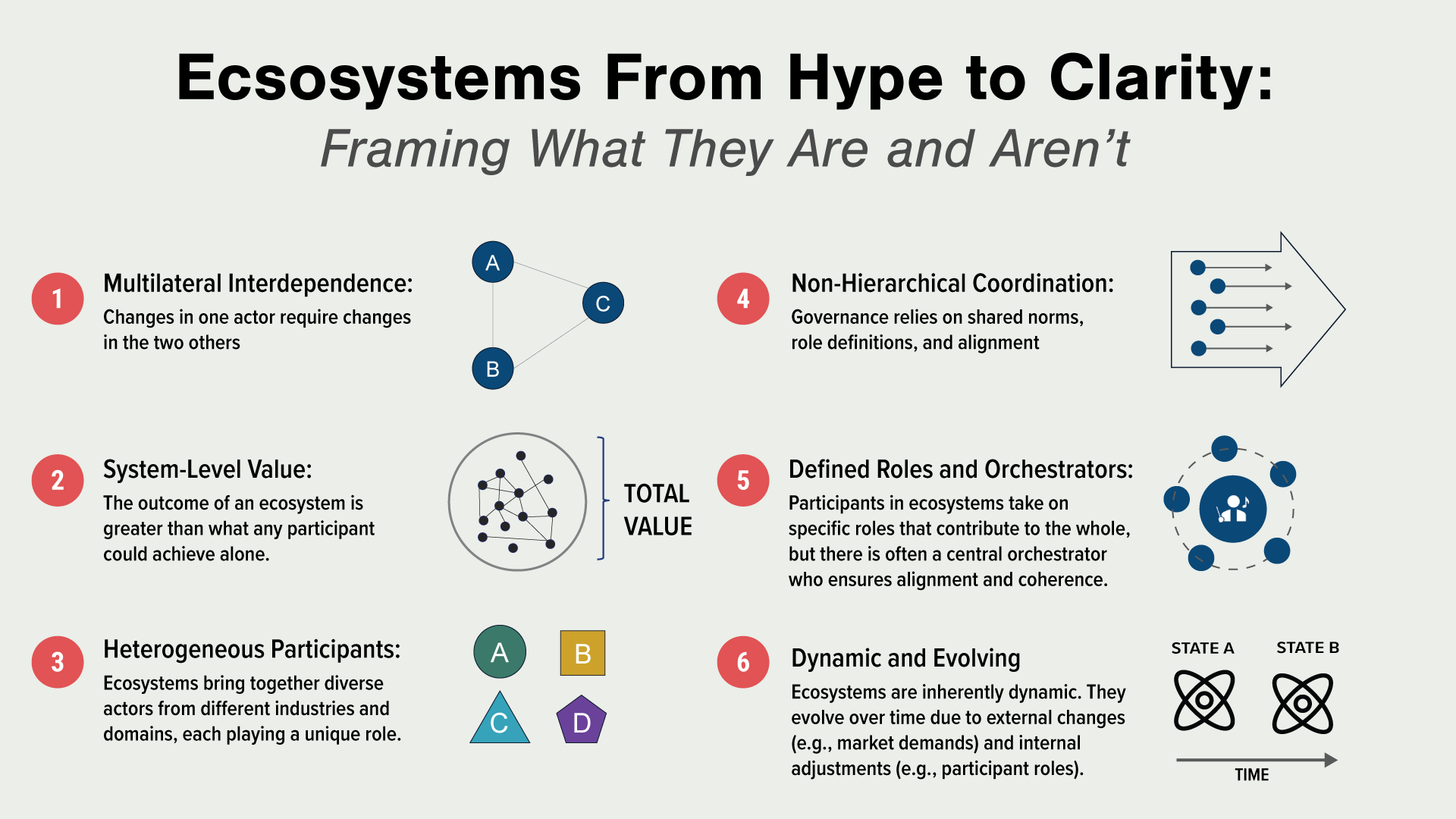
- Customer Centricity: The organizing principle shifts from products and industries to customer needs and outcomes. The aim is to orchestrate an integrated experience that solves the full end to end job for the customer, linking complementary services and touchpoints into one coherent journey. This reflects the jobs to be done view and the move toward competing through coordinated complements rather than isolated offerings.
- Interdependence: An ecosystem is a network of firms in an intentional business relationship that serve overlapping customers and combine expertise, technology, and products to create value none could deliver alone. When one part of the system changes, effects ripple across the others, altering incentives, performance, and coordination needs throughout the whole.
- Collaboration: Ecosystems depend on independent firms collaborating and coordinating resources and activites. Participants are aligned by incentives, governance structures, standards, and a common goal – the customer segment(s) and value proposition(s). Together they deliver a coherent experience for the customer.
- Structure and Governance: A business ecosystem has a defined structure built around an orchestrator that sets the rules of interaction and provides the platform or coordination mechanism. What distinguishes an ecosystem from a market is the role of complementors. In a market, participants compete by offering substitutable goods and services. In an ecosystem, participants provide complementary contributions—products, services, or technologies that gain value from being combined with others. Governance defines how these complements interoperate, how conflicts are resolved, and how shared assets and data are managed. This structure allows the ecosystem to generate collective value that no single firm or open market exchange could achieve.
Ecosystems as the Locus of Value Creation Within Broader Arenas
The concepts of “competitive arena” and “business ecosystem” are not contradictory; rather, they are complementary and operate at different levels of strategic analysis. The most powerful way to synthesize these views is to understand business ecosystems as the specific, value creation networks that exist within broader, macro level competitive arenas.
This “ecosystem in arena” model provides a multi layered strategic map. An organization must first comprehend the macro level arena it wishes to compete in (e.g., the Healthcare Arena) to understand the overarching competitive forces, technological trends, and regulatory landscape.
Having done this, it must then develop a specific, granular strategy to build or participate in one or more ecosystems within that arena (e.g., the “Preventative Wellness Ecosystem” or the “Chronic Disease Management Ecosystem”).
While some analyses, particularly those starting from a top down customer need, use the term ‘ecosystem’ to describe the entire macro domain (e.g., ‘Mobility Ecosystem’), this is not the most effective way of applying ecosystem thinking.
True ecosystem logic focuses on the specific, dynamic, and collaborative networks of actors creating value together. Therefore, it is more precise to define the broad competitive domain as the ‘arena,’ and the specific, intentionally formed value networks within it as ‘ecosystems.’
Table 1: Conceptual Framework: Competitive Arenas vs. Business Ecosystems
| Dimension | Competitive Arena | Business Ecosystem |
| Core Definition | A broad, macro level competitive domain where multiple industries converge to serve a general category of customer needs (e.g., Healthcare, Mobility). | A specific, cross sector network of interconnected businesses organized around a focused customer job to be done or value proposition within an arena. |
| Primary Focus | Defining the overall field of play and the major competitive forces at a macro level. | Fulfilling a specific, holistic customer journey (e.g., diabetes management, home purchasing). |
| Key Actors | A diverse set of industry incumbents, digital disruptors, and focused specialists competing across the entire domain. | Orchestrator and Complementors/Participants collaborating within a defined value proposition. |
| Strategic Goal | To identify and navigate the most attractive domains for long term value creation. | To grow the overall “pie” of a specific value proposition through collaborative value creation and capture a share of it. |
| Underlying Logic | Industry convergence, delayering of traditional value chains, and transient advantage. | Co evolution, collaboration, network effects, and customer centricity. |
The Forces Reshaping Strategy
The competitive landscape is fundamentally changing due to interconnected forces reshaping business. Digital technology has enabled new customer expectations, which in turn create different ways to compete and win.
Platforms, Data, and AI Erase Sector Borders
Digital technology is the primary engine of this transformation, redefining the face of business on a massive scale. A confluence of technological advancements has acted as the catalyst, erasing the boundaries that once neatly defined industries. These advancements include ubiquitous connectivity, cloud computing, data sharing platforms, and artificial intelligence.
The “exponential effect” of this technological growth empowers players in one sector to capture value far beyond their traditional borders.
At the heart of this technological shift are digital platforms, which serve as the essential coordination mechanism, the connective tissue that holds ecosystems together. These platforms facilitate the frictionless exchange of data, services, and money among participants. Payments play a crucial role as a “layer of connective tissue,” enabling transactions. By providing a common infrastructure for interaction and value exchange, these digital platforms are the practical means by which sector borders are dissolved.
From Value Chains to Integrated Life Journeys
Technology is the enabler, but the direction of change is dictated by the customer. he entire economic reorganization is a fundamental pivot away from industry defined value chains toward structures organized around “key customer needs”.
The ultimate goal of an ecosystem strategy is to meet this expectation by creating a single “integrated experience” that fulfills a variety of cross sectoral needs. The tangible outcome is the transformation of a series of fragmented, frustrating transactions into a seamless, integrated and connected experience. This shift from a product centric to a journey centric view is the core mandate for customer’s today.
In the traditional industry model, competitive advantage was rooted in controlling physical assets or proprietary processes within a firm’s value chain. In the ecosystem model, the center of gravity shifts to the control and orchestration of customer data across a network of partners. The “disproportionate power” that ecosystem orchestrators wield stems directly from their ownership of the customer touchpoint and the data that flows from it.
The Competitive Advantage Shift
A completely new strategy playbook is needed to win, one based on a “competitive arena”. Strategy ceases to be a static five year plan and becomes a dynamic process of constant experimentation, risk reduction, and rapid resource reconfiguration.
This shift fundamentally alters the sources of competitive advantage. The focus moves away from traditional “moat” advantages based on cost leadership or differentiation within a stable industry structure. Instead, advantage is derived from “turnstile” advantages based on generating network effects, fostering complementarities between partners, and aggregating users and their data.
How to Compete and Win In A Competitive Arena
Leaders require need to shift to an ecosystem strategy. This involves three critical decisions: choosing a role within an ecosystem, designing the ecosystem for success, and building the capabilities required to execute.
Choosing Your Ecosystem Role
The first and most fundamental strategic choice a firm must make is what role it intends to play within the ecosystem’s layered structure. This framework defines four distinct types of actors:
- Infrastructure: These are the digital infrastructures, such as AWS and Google, that provide the foundational layer. Their connection to the ecosystem is that they provide the core compute, storage, and networking capabilities that all upper layers build upon.
- Partners: These actors are enablers that provide resources and capabilities for orchestrators to be able to create value. They bridge infrastructure capabilities into higher level services and resources that orchestrators can leverage. Partners are often connected across different arenas through shared capability providers.
- Orchestrators: These actors produce a core value proposition for a customer and a core asset or assets that enable producers to create complementary value propositions. This allows the customer to achieve their job to be done. Orchestrators create platforms and ecosystems by combining partner capabilities. They are connected across arenas through barrier nodes which represent obstacles like platform barriers, core asset barriers, or orchestration capability barriers.
- Producers: These actors create complementary value propositions within the ecosystems built by orchestrators. They build offerings that work within orchestrator platforms to help customers achieve their jobs to be done. Producers are connected across arenas through barrier nodes representing obstacles such as capability barriers, customer access barriers, or regulatory barriers.
Designing a Winning Ecosystem
For firms that do choose the path of orchestration, there are three essential pillars for success.
Pillar 1: Attract Indispensable Partners: An ecosystem is a voluntary coalition. Partners cannot be forced to join; they must be enticed by a compelling value proposition that clearly benefits them. This requires the orchestrator to think not only about the end customer but also about the needs and incentives of its contributors.
Pillar 2: Master Governance: Effective governance strikes a delicate balance between “open” elements, which are necessary to attract partners and stimulate innovation, and “closed” elements, which are required to ensure consistent quality, protect intellectual property, and align incentives.
Pillar 3: Prioritize Scale Before Scope: Successful ecosystems almost invariably follow a path of scaling before broadening their scope. They begin with a simple, clear value proposition of limited scope, focus obsessively on building a large and active user base, and only then begin to add new features and services.
The Competitive Arena Strategy: New Capabilities, Partnerships, and M&A
Effective execution in the world of arenas and ecosystems demands new approaches and capabilities. A static, top down strategic plan is insufficient; what is required is a dynamic, design led process of continuous development and adaptation.

The three phase, design led approach to execution:
- Define the Strategy: This phase involves
- research to home in on the highest value use cases and customer segments. It combines qualitative design research methods like ethnographic studies with quantitative market sizing and value pool analysis.
- Design the Ecosystem: This phase translates strategy into a concrete operational plan. It involves creating detailed service blueprints and customer journey maps that articulate, step by step, how the ecosystem will operate from the perspective of consumers, partners, and employees.
- Build the Ecosystem: This phase focuses on creating a flexible and agile operating model capable of not only launching new solutions but also managing the entire portfolio of value propositions over time, which includes addressing failures, branching into new areas, and pivoting as the market evolves.
This process necessitates the development of new organizational capabilities. A new, more agile operating model is crucial, supported by a governance structure that fully integrates design disciplines into the day to day delivery of services. Furthermore, firms often cannot build all the required capabilities internally.
Competitive Arena and Ecosystems Examples
The following case studies, drawn from the provided research, illustrate the diverse ways in which leading companies are navigating and shaping arenas and ecosystems across different sectors.
Deconstructing Ping An’s Dominance Across Arenas

The Chinese financial services giant Ping An stands as an example of an incumbent that has successfully transformed itself into a dominant orchestrator of multiple ecosystems across several arenas. Originally a traditional insurance company, Ping An has evolved into a sprawling, technology driven conglomerate that operates ecosystems in the Financial Services, Healthcare, and Real Estate arenas.
The company’s strategy is organized around key “Life Areas,” which function as distinct ecosystems.
It includes major platforms in digital healthcare (Ping An Good Doctor, with over 300 million users), automotive services (Ping An Good Car), real estate (Ping An Good Home), and even smart city solutions.
This strategy has produced staggering results. Ping An now generates a full one third of its new customers from its various ecosystem ventures, which boast nearly 700 million users. This demonstrates the immense power of building multiple ecosystems as a customer acquisition and cross selling engine.
Ping An serves as a blueprint for how incumbents can leverage their existing assets (such as a large customer base and trusted brand) to move into adjacent ecosystems, create holistic solutions, and build a formidable competitive moat that digital native startups struggle to replicate.
Tesla More Than A Car Company
Tesla provides a powerful case study of a company that defines its strategy not by industry, but by arena. CEO Elon Musk has repeatedly insisted that viewing Tesla as just an auto company is the “wrong framework” .
Tesla’s strategy is to build ecosystems that addresses a broad customer need for clean energy and transportation. This is expressed through its operations in at least three major arenas:
- The Mobility Arena: This is the most visible arena, where Tesla competes with its electric vehicles. The company’s strategy here is one of differentiation, using superior technology, performance, and a direct to customer sales model to build a powerful brand and competitive advantage. The ecosystem is based on the Tesla platform, its charging standards and network, and partners.
- The Energy Arena: Tesla’s “Master Plan” was never just about cars; it explicitly included providing “zero emission electric power generation options”. Through its acquisition of SolarCity and the development of products like the Powerwall battery, Tesla competes in the renewable energy ecosystem, offering solutions for residential energy generation and storage.
- The AI and Robotics Arena: This is the future facing expression of Tesla’s strategy. Musk’s insistence that Tesla is an AI company is rooted in its massive investment in autonomous driving technology and, more recently, the development of the Optimus robot. The goal is to leverage its real world data fleet to create a dominant AI that can be deployed not just in cars, but in a future of autonomous ride sharing and humanoid robots.
Apple’s Multi Arena Ecosystem Strategy
Apple’s success offers a masterclass in leveraging a core set of products to build powerful, interlocking ecosystems across multiple competitive arenas. Rather than focusing on a single platform, Apple uses its integrated hardware, software, and services to create distinct but connected user experiences in different domains, most notably in the Healthcare and Lifestyle arenas.
The iPhone is the central hub of this strategy, but it is not a product confined to a single arena. Instead, it acts as the key that grants users access to Apple’s various ecosystems. The true power of Apple’s strategy is revealed through the Apple Watch, a device that simultaneously spearheads the company’s push into two distinct arenas:
- The Healthcare Arena: The Apple Watch is far more than a timepiece; it is a personal health monitoring device. Through features like ECG, heart rate monitoring, and fall detection, Apple has entered the healthcare space. Apple actively collaborates with the medical community, including major research hospitals like Stanford and Brigham and Women’s Hospital, to conduct large scale health studies and validate its technology. By integrating this data into the Health app, Apple is creating a comprehensive health ecosystem that empowers both patients and providers.
- The Fitness and Lifestyle Arena: Simultaneously, the Apple Watch is the anchor for the company’s ecosystem in the wellness and lifestyle arena. Features like the Activity Rings and the Workout app encourage daily activity and a healthier lifestyle. This is further expanded by the Apple Fitness+ subscription service, which provides a catalog of guided workouts and meditations, creating a sticky, recurring revenue stream built around user wellbeing.
The Leadership Mandate: Leading in a World Without Borders
Ultimately, the transition to an arena centric strategy is a leadership challenge. It requires senior executives to personally champion a profound cultural and mental shift within their organizations. This new leadership mandate involves four key actions:
Action: Champion the Mindset Shifts. Leaders must actively drive the four critical mindset shifts: from a focus on internal efficiency to external value creation; from an inward looking view of capabilities to an outward looking search for partners and producers; from a zero sum goal of value capture to a positive sum goal of joint value creation; and from a reliance on hierarchical control to a mastery of networks, coordination, governance, collaboration and influence.
Action: Develop and Communicate an Ecosystem Vision. Leaders are responsible for creating and articulating a compelling “ecosystem vision”, a clear mental model of how the firm, in concert with its partners, will create unique value through multilateral complementarities. This vision must be communicated relentlessly to align internal teams and attract external partners.
References
References
AHA Center for Health Innovation (2022). 5 Ways Apple Provider Partnerships Are Guiding the Future of Care. American Hospital Association. Available at: https://www.aha.org/aha-center-health-innovation-market-scan/2022-08-02-5-ways-apple-provider-partnerships-are-guiding.
Apple Inc. (2022). How Apple is empowering people with their health information. Apple Newsroom. Available at: https://www.apple.com/newsroom/2022/07/how-apple-is-empowering-people-with-their-health-information/.
Apple Inc. (2025). New holistic Apple Health Study launches today in the Research app. Apple Newsroom. Available at: https://www.apple.com/newsroom/2025/02/new-holistic-apple-health-study-launches-today-in-the-research-app/.
Apple Inc. (n.d.). Hospital Care. Apple. Available at: https://www.apple.com/healthcare/hospital-care/.
Christensen, C. et al. (2007). Finding the Right Job for Your Product. MIT Sloan Management Review. Available at: https://sloanreview.mit.edu/article/finding-the-right-job-for-your-product/
Fuller, J., Jacobides, M.G. and Reeves, M. (2019). The Myths and Realities of Business Ecosystems. MIT Sloan Management Review. Available at: https://sloanreview.mit.edu/article/the-myths-and-realities-of-business-ecosystems/.
Hagiu, A. and Wright, J. (2022). Shopify or Amazon, that is the question. Harvard Business Publishing Education. Available at: https://store.hbr.org/product/shopify-or-amazon-that-is-the-question/IM1305.
Jacobides, M. (2021). The End of Strategy in Business Ecosystems? Business Ecosystem Alliance. Available at: https://business-ecosystem-alliance.org/2021/06/16/the-end-of-strategy-in-business-ecosystems/.
JMIR Publications (2024). Consumer Smartwatches for Health Care: Framework and Review. Available at: https://pmc.ncbi.nlm.nih.gov/articles/PMC11549588/.
J.P. Morgan (n.d.). The rise and rise of ecosystem-based businesses. Available at: https://www.jpmorgan.com/payments/payments-unbound/magazine/articles/future-of-business-ecosystems.
KPMG International (2024). Transforming the enterprise of the future: The new champions in a digital era.
Kwan, A. et al. (2024). Optimizing digital ecosystems to create more value. Deloitte Insights.
Leavy, B. (2014). Rita McGrath explores the risks and opportunities of the transient-advantage economy. Strategy & Leadership. Available at: https://www.researchgate.net/publication/263187560_Rita_McGrath_explores_the_risks_and_opportunities_of_the_transient-advantage_economy.
Leavy, B. (2014). Strategy, organization and leadership in a new “transient-advantage” world. Strategy & Leadership.
McCullen, A. (2020). EP 237: End of Competitive Advantage with Rita McGrath. The Innovation Show. Available at: https://theinnovationshow.io/episode/ep-237-end-of-competitive-advantage-how-to-keep-your-strategy-moving-as-fast-as-your-business-with-rita-mcgrath/.
McGrath, R. (2018). January 2018 Newsletter. Available at: https://www.ritamcgrath.com/wp-content/uploads/2019/03/January-2018-Newsletter.pdf.
McKinsey & Company (2021). A design-led approach to embracing an ecosystem strategy.
McKinsey & Company (2021). Digital ecosystems for insurers: No one size fits all.
MDPI (2024). System Approach to the Process of Institutional Transformation for Industrial Integrations in the Digital Era. Available at: https://www.mdpi.com/2079-8954/12/4/120.
Musk, E. (2006). The Secret Tesla Motors Master Plan (just between you and me). Tesla. Available at: https://www.tesla.com/secret-master-plan.
Reeves, M., Lotan, H., Legrand, J. and Jacobides, M.G. (2022). What Is Your Business Ecosystem Strategy? Boston Consulting Group.
Reuter, C. and Floyd, S.W. (2023). Strategic leaders’ ecosystem vision formation and digital transformation: A motivated interactional lens. Strategic Management Journal. Available at: https://www.researchgate.net/publication/376864670_Strategic_leaders’_ecosystem_vision_formation_and_digital_transformation_A_motivated_interactional_lens.
Shilling, E. (2024). Elon Musk Insists Tesla Is An A.I. Company. So Why Not Spin Off The Car Business? InsideEVs. Available at: https://insideevs.com/news/717357/tesla-should-spin-off-car-business/.
The Digital Insurer (n.d.). China In-depth: Digital platforms creating effective partnerships. Available at: https://www.the-digital-insurer.com/china-in-depth-digital-platforms-creating-effective-partnerships/.
Valkokari, K. (2020). Business, Innovation, and Knowledge Ecosystems: How They Differ and How to Survive and Thrive within Them. Technology Innovation Management Review. Available at: https://pmc.ncbi.nlm.nih.gov/articles/PMC7444472/.
Yoffie, D.B. and Cusumano, M.A. (2015). As cited in: Leveraging Internal Capabilities for Competitive Advantage: A Case Study of Apple Inc. ResearchGate. Available at:https://www.researchgate.net/publication/391347739_Leveraging_Internal_Capabilities_for_Competitive_Advantage_A_Case_Study_of_Apple_Inc.


