Table of Contents
Making Sense of the Ecosystem Hype
The term “ecosystem” has become a buzzword – a catch-all label, applied to a wide range of ideas.
From digital ecosystems to HR ecosystems to dynamic ecosystems, it seems everything now qualifies as one.
With all the hype it’s often hard to identify what is an ecosystem and what are the core principles that differentiate it from other ways of organising.
This proliferation of terminology is like trying to call every group of organisms in nature a rainforest — it’s inaccurate and misleading.
If we don’t define ecosystems properly, we risk muddying the waters so much that understanding, managing, or even developing an ecosystem strategy becomes impossible.
There are some fundamental types of ecosystems and they do differ (I’ll cover this in later posts) but there are some common principles as well.
To cut through the noise, let’s focus on some of the core characteristics of ecosystem and how they differ from other structures like supply chains, networks, and markets.
By examining these different perspectives we can gain some clarity and provide a set of principles that form building block for how we design, develop and manage ecosystems.
What Is A Business Ecosystem? Key Perspectives
1. The System Level View: Four Principles
From a general perspective ecosystems there are four key characteristics that are commonly accepted as how an ecosystem differs from other ways of organizing:
A. System-Level Outcomes:
- Ecosystems produce outcomes greater than the sum of individual efforts.
- For example, an electric vehicle ecosystem integrates battery producers, charging infrastructure providers, and automobile manufacturers to deliver a seamless driving experience. (the output is greater than the sum of the parts)
B. Heterogeneous Participants:
- Ecosystems encompass diverse actors — businesses, regulators, consumers, and institutions — often spanning industries.
- Contrast this with a supply chain, where roles are more homogeneous (e.g., suppliers and manufacturers).
Interdependence:
- Participants rely on one another through physical, technological, economic, or cognitive links.
- Think of a smartphone ecosystem: app developers depend on the platform provider, hardware producers, and telecommunications providers to reach consumers.
Non-Contractual Coordination:
- Ecosystems operate via informal, non-contractual mechanisms like shared goals, norms, and modular designs.
- This contrasts with supply chains, where formal contracts govern interactions.
2. Ecosystems vs. Markets and Vertical Industries
Most firms produce a product or service by integrating components from (downstream) suppliers. In ecosystems value is frequently created through value additions to the core assets (upstream).
In a traditional model, firms like Apple integrate components from downstream suppliers, such as processors from TSMC, screens from Samsung, and batteries from various manufacturers, to assemble the iPhone. This integration forms the core product.
However, in the ecosystem model, value is created upstream through additions to core assets. For Apple, this means enabling app developers to create applications for iOS, which enhance the iPhone’s utility and appeal. These apps, built by independent developers, generate value that flows back to the ecosystem, enriching the core product and driving customer engagement.

By contrasting ecosystems with markets and vertical industries:
A. Markets:
- Markets are transactional, governed by prices. Buyers and sellers interact independently, and relationships are often fleeting.
- Ecosystems, by contrast, foster long-term, multilateral interdependence built on shared complementarities.
B. Vertical Industries:
- Vertical industries rely on sequential value creation: raw materials pass through a linear process (e.g., mining to manufacturing to retail).
- Ecosystems disrupt this model by enabling simultaneous collaboration across diverse players, often leveraging modularity and shared standards.
C. Complementarities and Modularity:
- Ecosystems thrive on supermodular complementarities, where the value of one component increases with the availability of another (e.g., the more apps a smartphone platform offers, the more valuable the device becomes).
3. The Alignment View
To produce a ecosystem output of value requires aligning actors towards a common vision and goal. It demands developing an ecosystem model synchronises across the system the flow of value:
Alignment Structure:
- An ecosystem is defined by the alignment of a multilateral set of partners who must interact for a specific value proposition to materialize.
- For example, in the case of autonomous vehicles, the ecosystem includes software developers, hardware providers, insurers, and regulators, all aligned to create a functional self-driving car.
Activity-Driven:
- Unlike networks, which emphasize relationships, ecosystems prioritize aligning discrete activities across participants.
- Activities must integrate seamlessly; a breakdown in one area (e.g., regulatory approval) can jeopardize the entire system.
Multilateral Dependency:
- Ecosystems require dependencies across multiple actors that cannot be decomposed into simple bilateral relationships. Success depends on mutual alignment, not just individual performance.
3. The Common Elements of Ecosystems
From these perspectives, we can distill the defining characteristics of ecosystems:
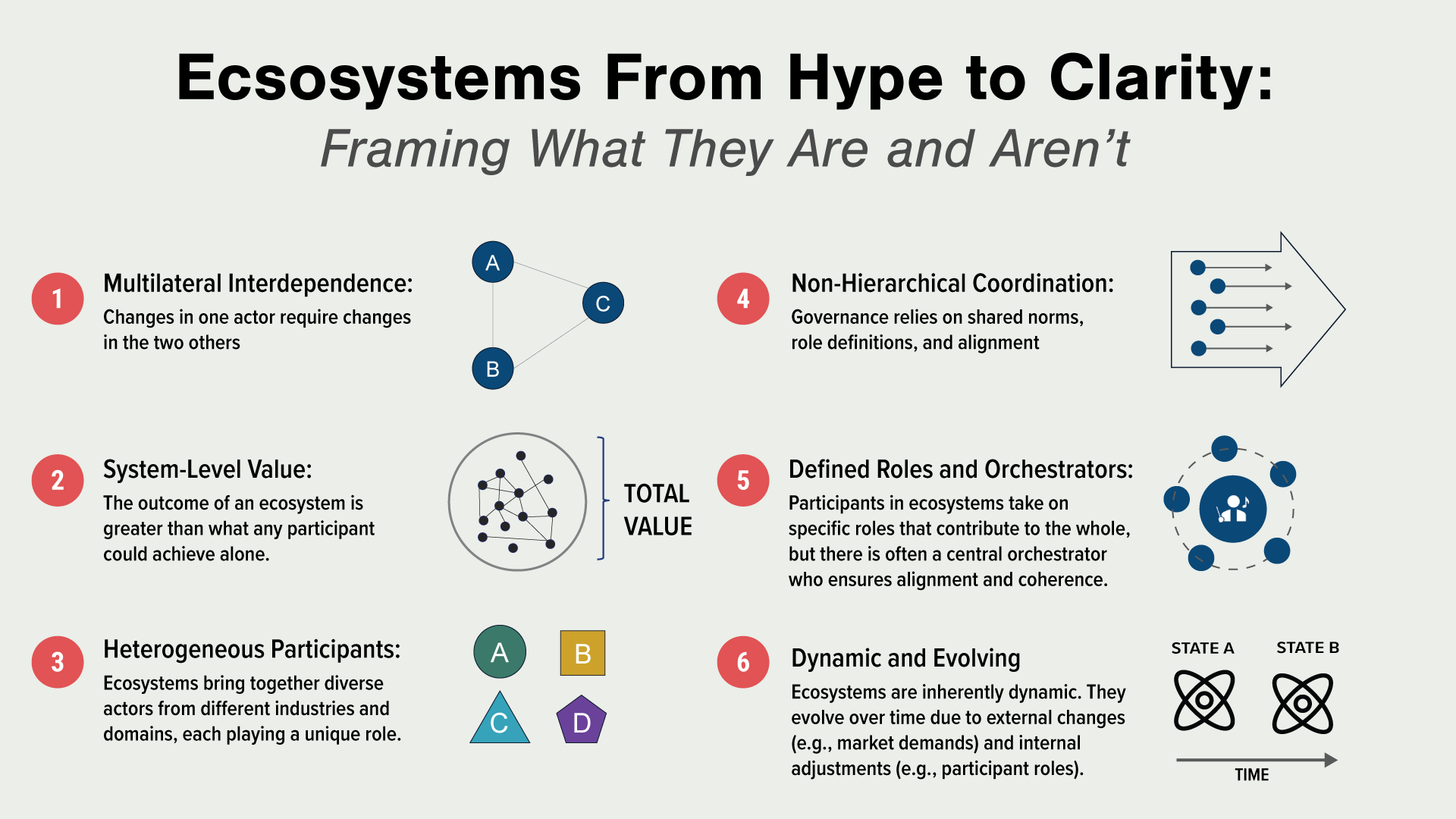
#1. Involve Multilateral Interdependent Relationships
- Ecosystems thrive on interdependencies that are non-linear and often simultaneous, unlike the sequential flow of supply chains.
#2. Produce A System-Level Ouput of Value
- The outcome of an ecosystem is greater than what any participant could achieve alone.
#3. Create (Upstream Value) Through Complementarities and Modularity
- Components and participants are interdependent but modular, allowing for flexibility and innovation.
#4. Involve Heterogeneous Participants (multi-industry and various types)
- Ecosystems bring together diverse actors from different industries and domains, each playing a unique role.
#5. Non-Hierarchical Coordination (contractual and non-contractual)
- Governance relies on shared norms, role definitions, and alignment incentives rather than rigid contracts.
#6. Defined Roles and Orchestrators
- Participants in ecosystems take on specific roles that contribute to the whole, but there is often a central orchestrator who ensures alignment and coherence.
- For example, in a symphony orchestra (a metaphor for ecosystems), the conductor represents the orchestrator, aligning the efforts of diverse musicians. Similarly, in a digital platform ecosystem, the platform provider often serves as the orchestrator.
- Roles can cluster into larger groups with common characteristics, like the “strings” or “winds” in an orchestra. In ecosystems, these might represent technical partners, regulatory bodies, or complementary innovators.
#7. Ecosystems are Dynamic and Evolve
- Ecosystems are inherently dynamic. They evolve over time due to external changes (e.g., market demands or technology shifts) and internal adjustments (e.g., participant roles or governance structures). Their adaptability ensures long-term relevance and resilience.
4. Comparing Ecosystems to Other Constructs
To understand ecosystems better, let’s compare them to supply chains, networks, and markets:

A Metaphor to Clarify Ecosystems
Think of an ecosystem as a symphony orchestra:
- Each musician (participant) plays a distinct instrument (role), contributing to a harmonious performance (system-level output).
- No single musician can produce the symphony alone; the value lies in their coordinated efforts.
- Unlike a supply chain, where a conductor might dictate every note, an ecosystem relies on each musician understanding their role and aligning with others informally.
- Modularity is evident in the sheet music — while each part is distinct, it fits seamlessly into the whole.
- The conductor (orchestrator) ensures harmony, but sections like “strings” or “winds” share commonalities and coordinate within themselves before integrating with the whole.
When an Ecosystem May Not Be Needed
While ecosystems offer compelling benefits, they are not universally the right governance model. There are some scenarios where an ecosystem might not be the optimal choice:
#A. Predictable Business Environments
- In stable and predictable industries where outcomes are well understood, ecosystems may introduce unnecessary complexity. A hierarchical supply chain or vertically integrated model can often achieve the same results more efficiently.
#B. High Integration Requirements
- For products or services that require tightly integrated solutions, ecosystems might lack the necessary control. For example, components that are not modular or require strict coordination may be better suited to an internally managed structure.
#C. Limited Need for Collaboration
- Ecosystems thrive on collaboration and interdependence. When the opportunity does not demand collective innovation or shared complementarities, simpler governance models like open-market competition might suffice.
#D. Strong Internal Capabilities
- If a company already has the resources, expertise, and capacity to innovate and scale internally, the added complexity of building an ecosystem may be unnecessary.
#E. Cost and Complexity of Coordination
- Building and managing an ecosystem requires significant investments in orchestration and alignment. When these costs outweigh the potential benefits, other models may be more practical.
By understanding these limitations you can better evaluate when an ecosystem is truly the right choice. Remember, industries change and therefore scanning the environment to understand if ecosystems are beginning to emerge and reshape the future is vital.
Summary of What Is A Business Ecosystem
Misusing the term “ecosystem” risks applying inappropriate strategies. Treating an ecosystem like a supply chain can stifle the flexibility and innovation it needs to thrive.
Conversely, treating a market or network like an ecosystem can overcomplicate simple interactions. By understanding the unique characteristics of ecosystems, organizations can:
- Design effective governance mechanisms.
- Foster collaboration without hierarchical control.
- Leverage complementarities to create unparalleled value.
Follow The Ecosystem Strategy Series:
Over the coming posts, I’ll dive deeper into:
- Where to Play: Learn to identify and evaluate the right ecosystem opportunities.
- How to Compete: Discover how to navigate overlaps, manage coopetition, and secure leadership against rival ecosystems.
- How to Get Started: Map your ecosystem, pinpoint value chain gaps, and launch pilots to experiment and scale effectively.
- The Value of Ecosystems: See how ecosystems grow the pie, unlocking new fields and markets rather than fighting over slices.
- Types of Ecosystems: Explore business, platform, innovation, and entrepreneurial ecosystems—each with unique dynamics and opportunities.
- Leveraging Core Assets: Understand how to use your strengths—data, technology, and expertise—to expand beyond traditional boundaries.
Learn the Essential Strategies to Develop and Win with Ecosystems:
Follow this series to gain the insights, strategies, and tools you need to lead in the ecosystem era. The future belongs to those who collaborate, innovate, and create value together.
References
- Adner, R. (2017). Ecosystem as Structure: An Actionable Construct for Strategy. Journal of Management, 43(1), 39–58.
- Autio, E., & Thomas, L. D. W. (2014). Innovation Ecosystems: Implications for Innovation Management. In Oxford Handbook of Innovation Management.
- Jacobides, M. G., Cennamo, C., & Gawer, A. (2018). Towards a Theory of Ecosystems. Strategic Management Journal, 39(8), 2255–2276.
- Pidun, U., Reeves, M., & Schüssler, M. (2019). Do You Need a Business Ecosystem? Boston Consulting Group Henderson Institute.
- Autio, E., Nambisan, S., Thomas, L. D. W., & Wright, M. (2018). Researching Ecosystems in Innovation Contexts. Research Policy, 47(8), 1398–1405.


