
This article is one in a series of articles that will go from explaining what is a platform to how to compete and win using platform ecosystems.
Table of Contents
What Is a Platform? A Guide to Networks and Digital Platforms
The modern economy is dominated by a handful of companies whose names have become verbs and whose scale would have been considered incomprehensible 20 years ago; e.g, currently Facebook has over 3 billion monthly active users.
Goliaths like Amazon, Apple, and Google have not only created successful products; they have fundamentally rewired the industries in which they operate.

However, it is important to recognise that they are not single, monolithic platforms. Instead, they have evolved to become vast platform ecosystems: complex networks of products, services, and technologies that interrelate and reinforce one another.
These technology giants leverage a diverse portfolio of digital platforms across their various business units. Amazon, for instance, combines a massive e-commerce marketplace (a transaction platform) with its cloud computing division, Amazon Web Services (an innovation platform). Apple masterfully integrates its hardware (like the iPhone and Mac) with its software and services (like iOS and the App Store) to create a tightly woven ecosystem that is famously difficult for consumers to leave.
The central question for any business leader today is not merely what these companies do, but how they orchestrate these complex systems.
\What is the underlying business model that powers their unprecedented growth and defensibility, and how does it differ from the industrial giants that dominated the 20th century?
The answer lies in mastering the platform business model. This article, the first in a series dedicated to deconstructing this powerful economic engine, will establish the foundational components of platform strategy.\
It will explain in clear terms why platforms exist, what defines them, how they create value, and what distinguishes them from the traditional businesses they are rapidly displacing.
The goal is to provide a clear, strategic vocabulary and a logical model for understanding one of the most significant economic transformations of our time.
Why Digital Platforms Exist: The Economics of Lowering Friction
At its core, any economic activity involves an interaction between two or more parties.
A buyer must find a seller, a service provider must connect with a client, and a creator must reach an audience. For any of these value-creating interactions to occur, the participants must overcome a series of obstacles and incur what economists call “transaction costs” or “coordination costs.”
These are not the price of the good or service itself, but the often-invisible costs of searching for a counterparty, screening for quality, building trust, negotiating terms, and settling the exchange. For much of history, these costs were prohibitively high, limiting commerce to local, high-trust environments.
The fundamental economic reason for digital platforms is to radically reduce coordination costs.
A digital platform is an organisational and technological construct designed to minimise the friction that inhibits or prevents value-creating interactions between different groups. By lowering these barriers, platforms facilitate exchanges that would otherwise be too difficult, too expensive, or too risky to occur.
A convergence of modern technologies has significantly enhanced this economic function. Pervasive connectivity, the ubiquity of smartphones, the availability of open-source software, and the power of cloud computing have dramatically lowered the cost of coordinating previously unacquainted entities at a global scale.
This technological revolution is the primary enabler of the modern platform economy, making it possible to organise markets and facilitate interactions with an efficiency and scope never before seen.
A Digital Platform Example
Consider the process of booking a hotel room for a vacation. In a pre-platform world, this was a high-friction activity.

A traveller might consult a travel agent, call hotels one by one from a directory, or rely solely on brand reputation. Comparing prices, amenities, and real-time availability was just difficult and very time-consuming.
There was no easy way to access unbiased reviews from previous guests to build trust. A platform like Booking.com or Airbnb streamlines this entire process (note that both of these platforms have evolved into platform ecosystems, which initially started as two-sided platforms).
The Booking.com platform offers a single, searchable database of accommodations, featuring powerful filters that enable instant price and feature comparisons. It also surfaces thousands of user-generated reviews, ensuring trust.
The platform also facilitates secure booking and payment processes, reducing each point of friction in the coordination process to make the interaction seamless and scalable.
The Abundance Effect

The continuous reduction in coordination costs through digitalisation has led to much lower entry costs for new firms.
The expense of setting up a dedicated marketplace for a niche interest, such as collectors of rare 19th-century maps, was too high relative to the potential transaction volume.
However, as technology drives the costs of search, payment, and reputation management toward zero, the economic threshold required to build and create a market has plummeted.
This allows platforms to profitably serve the “long tail” of niche interests that were previously too fragmented and small to be commercially viable.
Consequently, platforms not only make existing markets more efficient; they also actively create entirely new markets by enabling niche producers and consumers to connect and transact with confidence.
The Anatomy of a Market: Sides, Value, and Exchanges
To understand the architecture of digital platforms, it is helpful to start with a simple, tangible analogue: the local farmers’ market. This centuries-old institution contains all the fundamental components of any market, providing a useful mental model for the more abstract digital platforms that now dominate our economy.
1: Digital Platforms – “Sides”
Every market is composed of distinct groups of participants, known as “sides.” In a farmers’ market, the two primary sides are the producers (the farmers, bakers, and artisans who bring their goods to sell) and the consumers (the shoppers who come to buy those goods). These sides are fundamentally interdependent.
Farmers are motivated to attend because they expect a concentration of shoppers, and shoppers are drawn to the market because they expect a wide variety of high-quality producers. The value of the market for each side is directly tied to the presence and scale of the other side. This mutual attraction is the seed of the powerful economic force known as network effects.
Digital platforms connect the sides of a market enabling the two to interaction, transact, and
2: Digital Platforms – “Value Unit”
The “value unit” refers to the specific item or service that a producer creates to be exchanged with a consumer. At the farmers’ market, the tangible goods on display are the value units: bushels of apples, bunches of carrots, loaves of bread, or jars of honey.
This is a direct analogue to how digital platforms structure their value units. For example, an Airbnb host creates a “listing” with photos, a description, and a calendar, which is the digital value offer that a guest consumes.
3: Digital Platforms – Market Organizer
he platform itself acts as the central organizer. It provides the digital infrastructure and services that enable producers and consumers to connect and transact. Unlike a traditional business that owns the goods it sells, the platform’s primary role is to facilitate these interactions, creating a trusted and efficient environment for value exchange.
A crucial function of the platform as an organiser is governance. Successful platforms are not merely neutral, passive conduits; they are actively managed to ensure the quality and integrity of interactions.
This involves establishing rules and standards that foster trust among participants who may not be familiar with one another. For example, content moderation on YouTube, host verification on Airbnb, and seller rating systems on eBay are all essential governance functions.
They are designed to encourage positive behaviour, manage risk, and maintain the health of the ecosystem, which is vital for attracting and retaining users on all sides of the platform.
Defining Digital Platforms: Engines for Repeatable Interactions
Building on the foundational concepts of markets and coordination costs, we can arrive at a formal, strategic definition. A digital platform is a business model that creates value by facilitating direct, repeated interactions between two or more distinct but interdependent groups of customers. This definition contains several critical elements that distinguish platforms from traditional businesses.
Linear Pipes vs. Platforms

A linear value chain characterises the traditional business model of the industrial era, often referred to as a “pipe.” It functions by sourcing inputs, transforming them through internal processes, and selling a finished product to a customer.
Value is created inside the firm, which owns and controls the inventory it sells. In stark contrast, a platform’s primary role is not production but connection and facilitation. Value is co-created by users outside the firm, and the platform provides the infrastructure for them to interact.
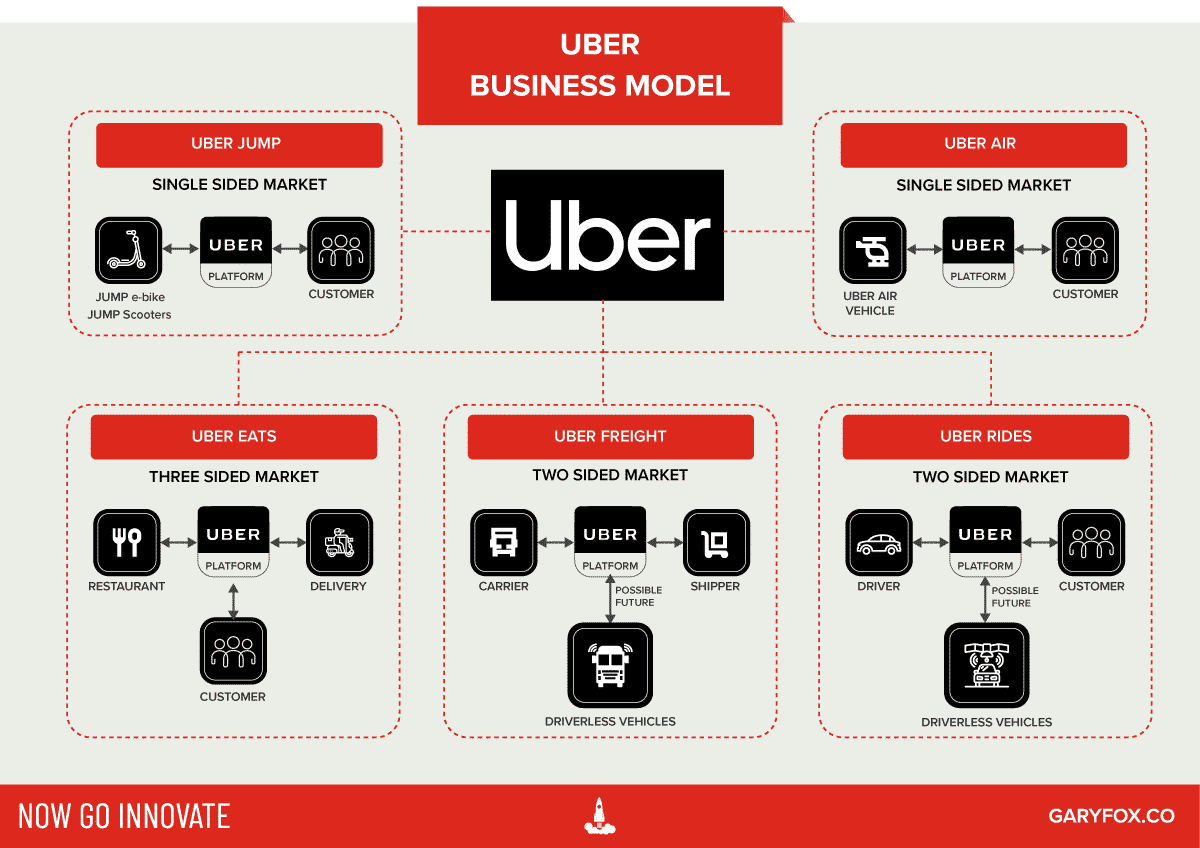
Uber owns no cars and Airbnb owns no real estate; they create the means of connection for drivers and hosts to serve riders and guests directly. This shifts the primary business asset from physical capital (like hotels) to the user network and its data, enabling a different model of growth. While Marriott must build a new hotel to add a room, Airbnb can add one for nearly zero marginal cost when a new host creates a listing.
This fundamental distinction redefines the core competencies required for success. A linear business manager focuses on asset optimisation, improving supply chains and controlling inventory. A platform manager, however, must master network orchestration.
The Core Interactions of Digital Platforms

Successful digital platforms are built around a single, essential, and repeatable process of value exchange between their users. This is known as the “core interaction” or “core transaction”. It is the primary sequence of actions that producers and consumers perform to co-create value.
Designing this interaction to be as simple and efficient as possible, ‘frictionless’, is the central task of platform design. This process can be understood as a multi-stage loop that acts as a self-reinforcing flywheel, turning potential connections into completed transactions.
While the specific steps vary by platform type, the loop generally follows this sequence:
- Discover: The process begins when a consumer recognizes a need and turns to the platform to find a solution. A rider, needing to get from one point to another, opens the Uber app. This step is about audience building and ensuring the platform is the top-of-mind solution for a specific need.
- Match: The platform’s technology facilitates a connection between the consumer and the most appropriate producer. Uber’s algorithm analyzes the rider’s location, nearby drivers’ availability, traffic conditions, and driver ratings to propose an optimal match. This matchmaking function is where a platform’s data and intelligence create immense value.
- Consume: The core value exchange takes place. A user consumes the value created by the producer. This can be a physical exchange, like the driver providing the ride, or a digital one, like a viewer watching a video on YouTube. This is the moment the consumer’s need is fulfilled.
- Value Exchange: The platform facilitates the “compensation” between the parties. On a transactional platform like Uber, this is a direct monetary payment from rider to driver. However, the value exchanged is not always financial.On ad-funded platforms like YouTube, consumers “pay” with their attention and data, which the platform monetizes with advertisers to compensate creators. On other platforms, the value exchanged with the producer might be social capital, reputation, or audience growth. The key is that both sides perceive a worthwhile exchange.
- Feedback and Improvement: The loop is closed by a feedback mechanism that signals quality, builds trust, and improves the platform. On Airbnb, this is an explicit two-way rating system. On a content platform like YouTube, feedback is often implicit: likes, shares, comments, and watch time all act as powerful quality signals. This data is a critical input for the platform’s algorithms, improving future matching and surfacing higher-quality value units for the next user.
The closing of the loop fuels the platform’s flywheel, builds trust within the platform and generates proprietary data that makes the platform more innovative and more efficient over time. It is what transforms a series of one-off transactions into a scalable, self-improving system.
Understanding Sidedness and Network Effects
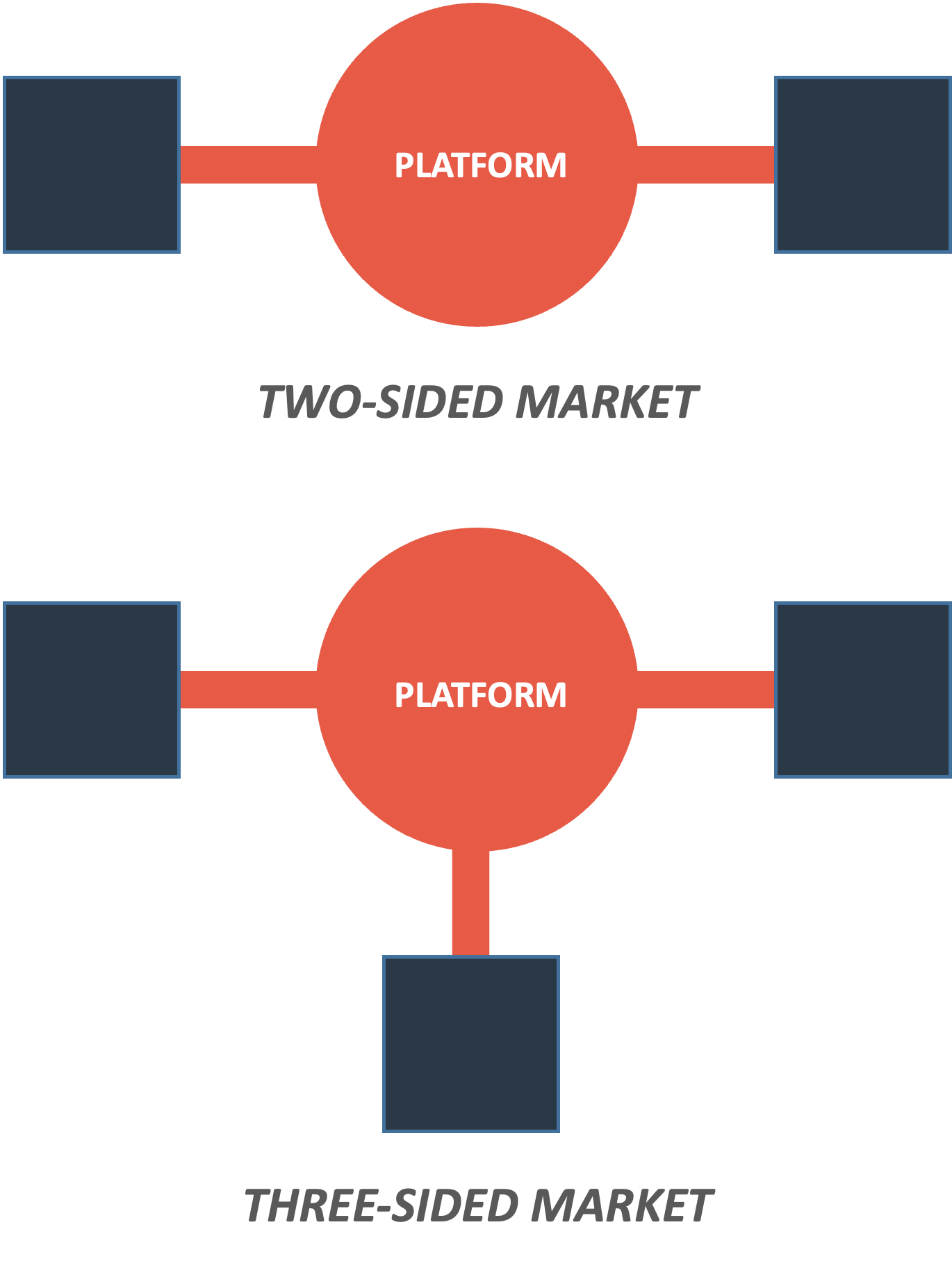
Platforms are often classified by the number of distinct user groups, or “sides,” they are designed to connect. The dynamic relationship between these sides is governed by one of the most powerful forces in business strategy: network effects. A network effect is the phenomenon whereby a product or service becomes more valuable as more people use it.Understanding the type of network effect a platform leverages is critical to understanding its strategy.
Direct Network Effects

In a one-sided network, the value for any given user increases as more users of the same type join the network. The benefit flows directly from one user to another user with similar characteristics. This is often referred to as a “direct” or “same-side” network effect.
The classic example is the telephone network: the very first telephone was useless, but the value of every phone in the network increased with each new subscriber that was added. Other examples include instant messaging apps like WhatsApp, where the value is directly proportional to the number of your contacts who also use the service.
Cross-Side Network Effects
A two-sided marketplace is a platform that connects two distinct but interdependent user groups. In this structure, the primary network effect is “indirect” or “cross-side”: the value for users on one side of the platform increases with the number of users on the other side.
For example, on eBay, buyers benefit from a larger selection when more sellers join, and sellers benefit from a larger pool of potential customers when more buyers join. On Uber, riders benefit from shorter wait times when more drivers are active, and drivers benefit from more ride requests when more riders use the app.

Essential Distinctions: What Digital Platform Are and Aren’t
The term “platform” is often used loosely, leading to strategic confusion. It is crucial to distinguish the platform model from other similar, but fundamentally different, business models.
Distinction 1: Platform vs. Platform Ecosystem

A single platform is not the same as a platform ecosystem. This distinction is key to understanding the scale and strategy of today’s dominant tech companies.
A single platform is not the same as a platform ecosystem. This distinction is key to understanding the scale and strategy of today’s dominant tech companies.
A platform is the technological foundation and organizing mechanism that enables interactions between different groups. It provides the core services, rules, and standards. For example, a classic transaction platform like eBay connects buyers and sellers, providing the tools for listing items, searching, and processing payments.
A platform ecosystem is the broader network of actors (like developers and users) and the complementary products and services (like apps and accessories) that are built around the core platform. The Apple ecosystem, for instance, encompasses not only the iOS innovation platform but also the App Store (a transaction platform), the hardware (iPhone), services (iCloud), and the vast community of third-party developers whose creations make the entire system more valuable.


Marketplace vs. Reseller (Merchant)
The key difference lies in who owns the inventory and controls the sale.
- A reseller operates a linear model: it buys products from suppliers, takes ownership of that inventory, and then resells them to customers.
- A marketplace is a platform that facilitates a direct transaction between a third-party seller and a customer, without ever owning the inventory. Amazon is a hybrid, acting as a reseller for items “Sold by Amazon” and a marketplace for third-party sellers.
Platform vs. Online Community
The distinction here is based on the primary purpose of user interaction.
- An online community‘s primary purpose is communication and connection among people with a shared interest. The core interaction is discussion.
- A platform’s primary purpose is to enable a transaction or an exchange of value. The core interaction is transactional, not conversational, though a platform may host a community to support its users.
Ad-Funded Media as a Two-Sided Platform
Many services that appear to be free are, in fact, sophisticated two-sided platforms.
- The Sides: One side is the user/audience consuming free content; the other is the advertiser wanting to reach that audience.
- The Value Exchange: The platform attracts a large user base and sells access to that audience’s attention to advertisers. The user’s attention is the product.
Digital Platforms Summary
The shift from linear, production-focused business models to networked, connection-focused platforms represents one of the most profound economic transformations in a century.
Understanding the foundational principles of this new model is no longer an optional exercise for strategists and leaders; it is a prerequisite for navigating the modern competitive landscape.
As this article has established, platforms are not simply tech companies; they are a distinct business model with a clear economic purpose: to reduce coordination costs and enable value-creating interactions.
They are built upon the core components of any market, distinct sides and a value unit, but use technology to facilitate these interactions at an unprecedented scale. Their engine is the core interaction loop, a self-reinforcing flywheel that builds trust and improves with every transaction. The specific architecture of a platform, defined by its “sidedness,” determines the nature of the network effects it can leverage and dictates its strategic challenges.
Finally, being precise about what a platform is—and what it is not—is critical for identifying the core risks and operational priorities of the business.
References
Adner, R. (2017) ‘Ecosystem as Structure: An Actionable Construct for Strategy’, Journal of Management, 43(1), pp. 39-58. Available at: https://doi.org/10.1177/0149206316678451
Anderson, S.P. and Jullien, B. (2015) ‘The advertising-financed business model in two-sided media markets’, in S. Anderson, D. Stromberg and J. Waldfogel (eds.) Handbook of Media Economics. Vol. 1. North-Holland, pp. 41–90. Available at: https://doi.org/10.1016/B978-0-444-62721-6.00002-0
Hagiu, A. and Wright, J. (2015) ‘Marketplace or Reseller?’, Management Science, 61(1), pp. 184-203. Available at: https://doi.org/10.1287/mnsc.2014.2042
Jacobides, M.G., Cennamo, C. and Gawer, A. (2018) ‘Towards a theory of ecosystems’, Strategic Management Journal, 39(8), pp. 2255-2276. Available at: https://doi.org/10.1002/smj.2904


