
In this article, you will learn about the different types of platforms and platform ecosystems. These platform archetypes set you up for determining what type of platform you need to design to solve a particular problem.
Table of Contents
Digital Platforms
The digital age has given rise to the platform business model. A platform business model does not operate in a linear fashion. Instead, it creates value by facilitating interactions between two or more distinct groups of external participants, typically producers and consumers.
Companies such as Airbnb, Uber, and YouTube do not own the primary value-creating assets like rooms, cars, or videos. Rather, they own the infrastructure and govern the rules that enable their platform ecosystems to connect and transact.
The platform business model represents a profound strategic shift. For digital platforms, the primary source of value creation shifts from within the firm to an external network of users and partners.
The firm’s most critical assets are no longer its physical capital but the community and the interactions it orchestrates.
This demands a complete reorientation of corporate strategy. Leaders must transition their thinking from resource control to resource orchestration, from internal process optimisation to external interaction management, and from maximising individual customer value to maximising the total value of the entire ecosystem. This is not a simple technological upgrade but requires a fundamental shift in mindset.

Platform Archetypes
At its core, a platform business model is not just a piece of technology. Before a platform can support a sprawling ecosystem, it must excel at its primary function. Understanding the two foundational types of platforms is the first step for any leader seeking to navigate this new competitive landscape.
Platform Archetypes: 1. Transactional Platforms
Transactional platforms act as digital matchmakers, connecting different groups of participants to facilitate the exchange of goods, services, or information. Their primary economic function is to reduce market friction, creating efficient markets where none may have existed before. As an example, the two-sided business model is a typical way to match sides.
In this model, the platform owner operates the digital infrastructure that connects producers with consumers. Value is created by enabling these connections and building trust between participants. Examples include marketplaces like eBay, service platforms like Uber, and labour platforms like Upwork.
Platform Archetypes: 2. Innovation Platforms
Innovation platforms provide a technological foundation upon which a vast network of third parties can build new products and services. These platforms solve innovation bottlenecks, acknowledging that a single firm cannot build every application its customers might want.
The platform owner provides a stable core, such as an operating system or a set of Application Programming Interfaces (APIs), and external developers, known as complementors (producers), innovate on top of this foundation. The value of an innovation platform is a direct function of the quality and variety of these complementary innovations. Prominent examples include operating systems like Microsoft Windows and Google’s Android.
| Types of Platforms | Definition | Core Function | Typical Participants | Examples |
|---|---|---|---|---|
| Transaction Platform | Enables direct exchange of goods, services, or value between distinct user groups. It facilitates transactions by matching supply and demand. | Reduce search, coordination, and trust costs between producers and consumers. | Buyers and sellers, hosts and guests, drivers and riders, advertisers and audiences. | Amazon Marketplace, Airbnb, Uber, eBay, Etsy, Booking.com, PayPal, Alibaba, Deliveroo, Upwork. |
| Innovation Platform | Provides a technological foundation or architecture that enables others to build complementary products or services. | Allow third parties to innovate and extend the core system through APIs, SDKs, or plug-ins. | Core platform owner and developers or complementors who build compatible solutions. | Microsoft Windows, Apple iOS, Google Android, Salesforce AppExchange, AWS, Nvidia CUDA, Meta Quest, Shopify App Store, Unity, OpenAI API. |
The Evolution to Platform Ecosystems
A simple platform connects two sides of a market. However, the true strategic power of the model is unlocked when a platform evolves to become the foundation of a dynamic platform ecosystem.
A platform ecosystem is a broader community of actors, including partners, developers, and other third parties, that form around the platform, creating a network of interconnected services and value streams.
In this evolution, the platform owner often transitions from a simple operator to an ecosystem orchestrator, managing a complex web of relationships to grow the value of the entire system.
Business ecosystems built on platforms generally fall into two categories: transaction ecosystems and solution ecosystems.
Types of Platforms: Platform Ecosystems
Transaction Ecosystems
Built around a transactional platform, these ecosystems function as large scale digital marketplaces. The orchestrator (the platform owner) links producers and consumers, and the ecosystem consists of all participants who transact on the platform.
A transaction ecosystem, however, represents a more evolved and complex environment. It moves beyond a single market to integrate multiple, diverse types of transactions under one umbrella, creating a “super app” experience. The quintessential example of this is WeChat.
While it began as a communication platform, it has since evolved into a comprehensive transaction ecosystem that encompasses numerous distinct markets. Within the single WeChat interface, users can access separate transactional platforms for ride-hailing, food delivery, e-commerce, and paying utility bills, all unified by a single payment system, WeChat Pay. In this model, the platform serves as the central orchestrator for a constellation of different markets, creating a true ecosystem of commerce and services rather than just a single marketplace.

Solution Ecosystems
Centred on an innovation platform, these ecosystems are designed to solve a customer problem by coordinating the contributions of multiple partners. The orchestrator provides a core technological foundation, and the ecosystem is composed of partners (complementors) who build specialised solutions on top of it for consumers. The value comes from the integrated whole, which is greater than the sum of its parts. The ecosystem around Google’s Android operating system, where countless hardware manufacturers and app developers build for a common standard, is a classic solution ecosystem.

Hybrid Ecosystems
The most formidable competitive models are hybrid ecosystems, which merge the capabilities of both transaction and solution platforms. These firms act as orchestrators of a broad platform ecosystem, operating a marketplace for exchanges while simultaneously providing a foundation for third-party innovation.

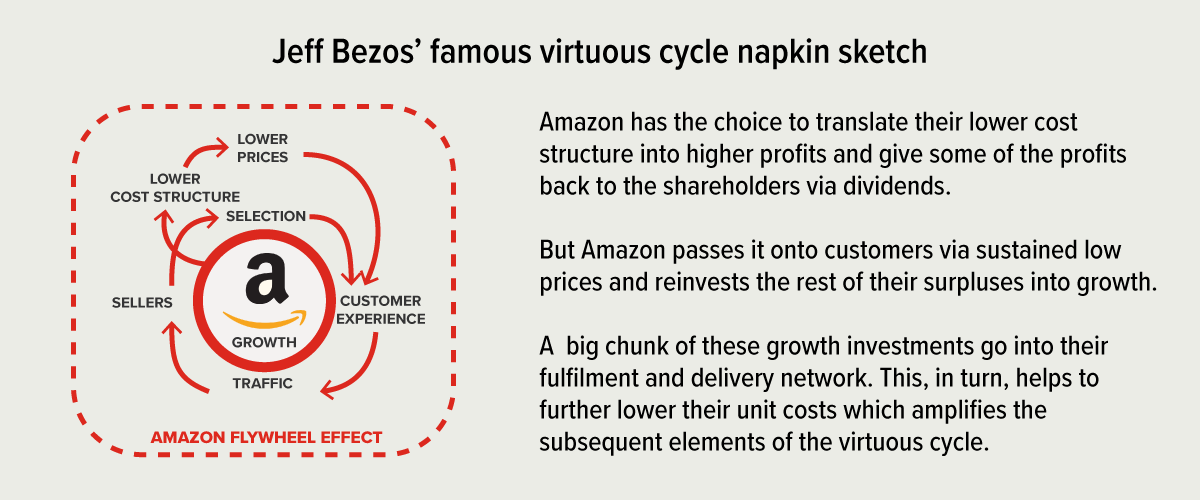
This synthesis creates a powerful flywheel. The innovation side makes the core product more attractive, drawing in more consumers. This large consumer base, in turn, makes the transaction side more lucrative for partners and producers. Apple is a prime example of this synthesis. Its iOS operating system serves as the innovation platform, providing the foundation for developers to create apps. Simultaneously, the App Store functions as a massive transaction platform, connecting those developers with millions of iPhone users.
Co-Innovation Ecosystems
A specialised type of solution ecosystem, the co-innovation model involves a hands-on approach from the orchestrator. Instead of simply providing a foundation and stepping back, the orchestrator actively participates in the innovation process. It matches partners with complementary skills and provides resources to solve complex, novel problems that no single firm could tackle alone.
This model is a managed ecosystem designed to de-risk collaborative breakthroughs, making it a powerful tool in industries like advanced manufacturing and healthcare. SAP’s Co-Innovation Labs, for instance, connect firms with different expertise to develop new solutions jointly.
Types of Platforms: Business to Business (B2B) Platform Ecosystems
The strategies of consumer-facing platforms cannot be directly applied to the business-to-business (B2B) world.
Different types of platforms operate in distinct contexts within b2B ecosystems. They are defined by more complex sales cycles, higher integration costs, and a greater emphasis on trust. While many consumer platforms are designed to address market failures, B2B platforms are often created to resolve coordination failures within complex value chains.
There are four distinct platform archetypes of B2B: Technology Enablement Platforms, Intelligent Products and Services Platforms, Data Aggregation and Collaboration Platforms, and Marketplaces.
| Platform Archetypes | Primary Goal | Core Value Proposition | Key Roles in the Ecosystem |
| Transaction Ecosystem | Facilitate Exchange | Reduce market friction by matching producers and consumers across multiple markets within a single platform. | Orchestrator (Platform Owner): Operates the platform. Producers: Offer goods or services. Consumers: Purchase goods or services. |
| Solution Ecosystem | Enable Solutions | Provide a foundation for partners to build complementary products and services, solving a coordination failure. | Orchestrator: Owns the core platform. Partners: Develop complementary offerings. Consumers: Use the integrated solution. |
| Co-Innovation Ecosystem | Orchestrate Breakthroughs | Actively manage collaboration between select partners to solve complex, novel problems. | Orchestrator: Actively manages projects and resources. Partners: Co-develop solutions with the orchestrator. Consumers: Benefit from the highly specialized solution. |
| Hybrid Ecosystem | Dominate the Market | Combine the value propositions of both Transaction and Solution ecosystems to create a self-reinforcing flywheel. | Orchestrator: Manages both the marketplace and the innovation foundation. Partners, Producers, Consumers: All participate in a multifaceted ecosystem. |
Strategic Platform Selection
For managers, choosing to build a platform and selecting the right type is a critical strategic decision. The optimal choice depends on the problem the business aims to solve and the assets it can leverage.
When to Build Which Platform
The fundamental question is not “What can we build?” but “What market or industry problem can we solve uniquely well?”.
- Build a Transactional Platform to solve for market friction. If an industry has fragmented buyers and sellers who struggle to find each other, a transactional platform can create immense value. The strategic focus must be on identifying an unmet customer need and designing a platform that serves it better than existing alternatives.
- Build an Innovation Platform to solve an innovation bottleneck. If a company possesses a core technology that can serve as a foundation for other firms to build upon, an innovation platform is the right choice.
- Build a Co-Innovation Ecosystem to solve novel, complex problems that are beyond the capabilities of any single organization. This model is ideal for industries where breakthrough innovation requires deep, hands on collaboration between diverse partners.
- Evolve to a Hybrid Ecosystem to achieve market dominance and long term defensibility. The world’s most powerful digital platforms combine transactional and innovation capabilities. This is often an evolutionary step, taken from a position of strength in one of the foundational models.
Critical Design Factors for Decision Makers
Once a model is selected, leaders must focus on a specific set of design factors tailored to that model.
- For Transactional Platforms, prioritize Trust and Liquidity. The platform is worthless until both sides are on board, so solving this “chicken and egg” problem is the primary design challenge. Success depends on creating density, a high concentration of good matches in a specific market, before trying to achieve scale.
- For Innovation Platforms, prioritize Partner Experience and Incentives. The core design challenge is to make the platform easy for partners to build upon. This requires a focus on the architecture and governance rules that balance openness with control. An overly closed platform will stifle third party innovation, while an overly open one can become fragmented and difficult to monetize.
- For Co-Innovation Platforms, prioritize Orchestration and Resource Access. The design must facilitate active, hands on collaboration. This means building capabilities to identify and match partners with complementary needs and skills. The platform must provide access to both technology and market resources to reduce the risk of the innovation process for all participants.
- For B2B Platforms, prioritize Integration and ROI. Unlike many consumer platforms, B2B platforms often succeed by solving coordination failures. This requires a design that prioritizes deep technical integration with partners’ existing systems. The value proposition must be clear and quantifiable, as corporate customers require a demonstrable return on investment.
Ultimately, selecting and designing a platform is not a one time decision but a continuous strategic process. Leaders must be prepared to evolve their platform’s design and governance as the ecosystem matures and the competitive landscape shifts.
References
The fundamental question is not “What can we build?” but “What market or industry problem can we solve uniquely well?”.
- Build a Transactional Platform to solve for market friction. If an industry has fragmented buyers and sellers who struggle to find each other, a transactional platform can create immense value. The strategic focus must be on identifying an unmet customer need and designing a platform that serves it better than existing alternatives.
- Build an Innovation Platform to solve an innovation bottleneck. If a company possesses a core technology that can serve as a foundation for other firms to build upon, an innovation platform is the right choice.
- Build a Co-Innovation Ecosystem to solve novel, complex problems that are beyond the capabilities of any single organization. This model is ideal for industries where breakthrough innovation requires deep, hands on collaboration between diverse partners.
- Evolve to a Hybrid Ecosystem to achieve market dominance and long term defensibility. The world’s most powerful digital platforms combine transactional and innovation capabilities. This is often an evolutionary step, taken from a position of strength in one of the foundational models.
Critical Design Factors for Decision Makers
Once a model is selected, leaders must focus on a specific set of design factors tailored to that model.
- For Transactional Platforms, prioritize Trust and Liquidity. The platform is worthless until both sides are on board, so solving this “chicken and egg” problem is the primary design challenge. Success depends on creating density, a high concentration of good matches in a specific market, before trying to achieve scale.
- For Innovation Platforms, prioritize Partner Experience and Incentives. The core design challenge is to make the platform easy for partners to build upon. This requires a focus on the architecture and governance rules that balance openness with control. An overly closed platform will stifle third party innovation, while an overly open one can become fragmented and difficult to monetize.
- For Co-Innovation Platforms, prioritize Orchestration and Resource Access. The design must facilitate active, hands on collaboration. This means building capabilities to identify and match partners with complementary needs and skills. The platform must provide access to both technology and market resources to reduce the risk of the innovation process for all participants.
- For B2B Platforms, prioritize Integration and ROI. Unlike many consumer platforms, B2B platforms often succeed by solving coordination failures. This requires a design that prioritizes deep technical integration with partners’ existing systems. The value proposition must be clear and quantifiable, as corporate customers require a demonstrable return on investment.
Ultimately, selecting and designing a platform is not a one time decision but a continuous strategic process. Leaders must be prepared to evolve their platform’s design and governance as the ecosystem matures and the competitive landscape shifts.
Types of Platforms References
Cusumano, M.A., Gawer, A. and Yoffie, D.B. (2019) The Business of Platforms: Strategy in the Age of Digital Competition, Innovation, and Power. Available at: https://www.hbs.edu/faculty/Pages/item.aspx?num=56021
Madsen, T.L. and Cruickshank, D. (2022) Co-Innovation Platforms: A Playbook for Enabling Innovation and Ecosystem Growth. Available at: https://www.researchgate.net/publication/357505355_Co-Innovation_Platforms_A_Playbook_for_Enabling_Innovation_and_Ecosystem_Growth
Parker, G.G., Van Alstyne, M.W. and Choudary, S.P. (2016) ‘Pipelines, Platforms, and the New Rules of Strategy’, Harvard Business Review. Available at:(https://ide.mit.edu/wp-content/uploads/2017/05/Pipelines-Platforms-and-the-New-Rules-of-Strategy.pdf.pdf)
Platform Thinking Labs (n.d.) The Three Design Elements for Designing Platforms. Available at: https://platformthinkinglabs.com/materials/the-three-design-elements-for-designing-platforms/
Schreieck, M., Wiesche, M. and Krcmar, H. (2020) ‘Digital Platforms and Market Dominance: Insights from a Systematic Literature Review and Avenues for Future Research’. Available at:(https://www.researchgate.net/publication/341452662_Digital_Platforms_and_Market_Dominance_Insights_from_a_Systematic_Literature_Review_and_Avenues_for_Future_Research)
Täuscher, K. and Laudien, S.M. (2017) ‘Understanding Platform Business Models: A Mixed Methods Study of Digital Marketplaces’. Available at:(https://www.researchgate.net/publication/316667830_Understanding_Platform_Business_Models_A_Mixed_Methods_Study_of_Digital_Marketplaces)
Van Alstyne, M. (2017) ‘Platform Strategy and the Internet of Things’, MIT Sloan Management Review. Available at: https://sloanreview.mit.edu/article/platform-strategy-and-the-internet-of-things/


