The Facebook business model is based on the hidden revenue business model pattern. In other words, the customer doesn’t pay for using the service.
Facebook’s revenue comes from businesses that advertise on the platform.
Facebook, now a part of Meta Platforms, Inc., is one of the most influential global social networking services.
Facebook was founded on connecting people. Its platform enables users to share content, engage in conversations, and maintain relationships regardless of geographical boundaries.
Despite controversies around privacy and misinformation, Facebook’s role in digital communication is unparalleled.
Table of Contents
A Brief History of Facebook (Meta)

Facebook’s journey began in 2004 in a Harvard dorm room when Mark Zuckerberg and his college roommates came up with the idea of providing a platform for students to put their profiles online.
Initially restricted to Harvard students, it rapidly expanded to other universities and eventually to the public. The platform’s user base grew exponentially, reaching one billion users by 2012.
Key milestones include its IPO in 2012, one of the largest in technology history, and the strategic acquisitions of Instagram in 2012 and WhatsApp in 2014.
These acquisitions expanded Facebook’s digital empire and diversified its user engagement strategies.
The company’s rebranding to Meta Platforms, Inc., in 2021 marked a strategic shift towards building a more immersive digital experience, dubbed the “metaverse.”
This vision aims to create a virtual space for users to interact through avatars, transcending the traditional boundaries of social media. The Facebook business model, therefore, is predicated on more immersive digital experiences. This is reflected in some strategic acquisitions reinforcing the new Meta business model.
Timeline of Key Facebook Milestones
Here is a timeline of key milestones in Facebook’s history, outlining its growth and transformation over the years:
2004: Founding of Facebook
- February: Mark Zuckerberg, along with Eduardo Saverin, Andrew McCollum, Dustin Moskovitz, and Chris Hughes, launched “The Facebook” at Harvard University. Initially, it was a social networking platform exclusive to Harvard students.
2005: Expansion to Other Universities and Name Change
- September: Facebook expanded to include other Ivy League schools and later universities across the U.S. and Canada. It dropped the “The” from its name and became Facebook.
- May: Facebook received its first major investment of $12.7 million from Accel Partners.
2006: Open to the Public
- September: Facebook opened registration to anyone over the age of 13 with a valid email address, marking its first step toward becoming a global social network.
2007: Facebook Ads Launch
- November: Facebook introduced Facebook Ads, allowing businesses to promote their products and services on the platform. It also launched the Facebook Pages feature, enabling brands and public figures to create a presence on the platform.
2008: Launch of Facebook Chat
- April: Facebook launched its instant messaging feature, Facebook Chat, allowing real-time user communication.
- June: Sheryl Sandberg was hired as the company’s Chief Operating Officer (COO), playing a critical role in Facebook’s growth and monetisation strategies.
2009: Like Button Introduced
- February: The “Like” button was introduced, allowing users to express approval or interest in posts and content. This feature became one of Facebook’s defining features.
2010: 500 Million Users and The Social Network Movie
- July: Facebook reached 500 million active users, becoming the dominant social networking platform.
- October: “The Social Network” movie, depicting the early years of Facebook and its founders, was released, further boosting public interest in the company.
2012: Initial Public Offering (IPO)
- May: Facebook held its Initial Public Offering (IPO), raising $16 billion in one of the largest tech IPOs in history. This event valued the company at over $100 billion.
- April: Facebook acquired Instagram for $1 billion, marking a key step in its expansion into photo sharing and visual content.
2014: Acquisition of WhatsApp and Oculus
- February: Facebook acquired WhatsApp for $19 billion, significantly expanding its presence in mobile messaging.
- March: Facebook also acquired Oculus VR, a virtual reality company, for $2 billion, indicating its interest in virtual and augmented reality technologies.
2016: Introduction of Facebook Live and Marketplace
- April: Facebook launched Facebook Live, a feature allowing users to broadcast live videos to their friends and followers.
- October: The company introduced Facebook Marketplace, a platform for users to buy and sell goods locally.
2018: Cambridge Analytica Scandal
- March: Facebook faced scrutiny after the Cambridge Analytica data scandal, where the data of 87 million users was harvested without consent for political advertising purposes. This led to significant public and regulatory backlash.
2021: Meta Rebranding
- October: Facebook announced its rebranding to Meta Platforms, Inc., reflecting its focus on building the metaverse, a shared virtual environment.
2023: Launch of Threads
- July: Meta launched Threads, a Twitter competitor, through Instagram to capitalise on the demand for text-based social networking.
Key Facts About Facebook
Facebook Inc
Mark Zuckerberg, Eduardo Saverin, Andrew McCollum, Dustin Moskovitz and Chris Hughes.
2004
2004
Mark Zuckerberg
Menio Park, California, USA
(Dec, 2023) 67,317
FB
2023: $134.9 Billion
2023: $39 Billion
(July, 2024): $1.171 trillion
Who Owns Facebook (Meta)
According to the latest data, Facebook is publicly traded under Meta Platforms, Inc.. Mark Zuckerberg is the CEO and holds significant voting power due to the company’s dual-class stock structure.
Institutional investors, including mutual funds, pension funds, and retail investors own other shares. Due to trading, the exact percentage and distribution shifts with market conditions.


How Facebook works
The Facebook business model primarily revolves around advertising revenue. It is a multi-sided market business model pattern with users, advertisers, and app developers, e.g., games.

In the case of Facebook the users have free use of the platform, advertisers pay to get ads in front of the users (ad spend), and Facebook also has games and apps produced by developers who make money on in-app purchases.
Other companies such as Google also have a hidden revenue model. This bascially means that the service is free to users but they make money behind the scenes through advertising.

The platform collects user activity, preference, and interaction data to deliver targeted advertisements. This model leverages user-profiles and how the data they share.
Data is the likes and content (including text and images) that is then analysed using sophisticated algorithms to target users with ads specifically.
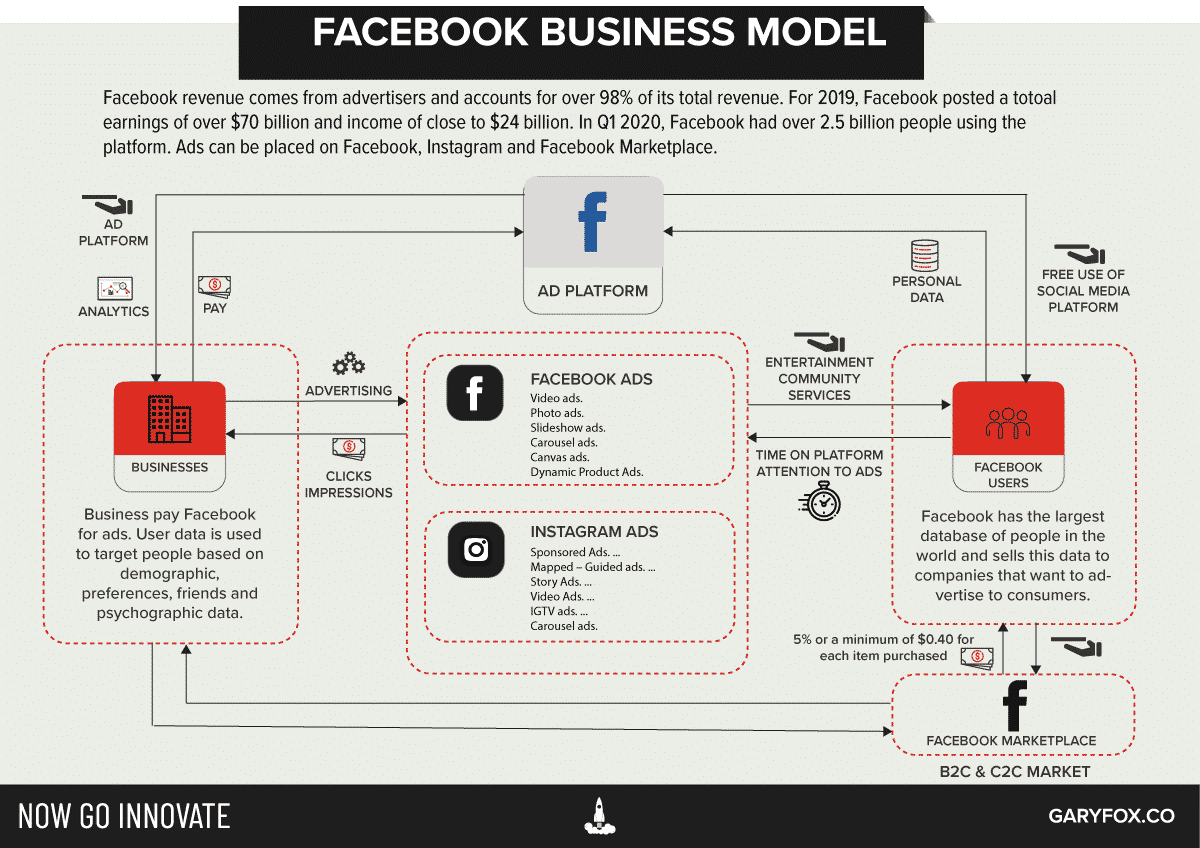
Additionally, Facebook offers various business tools, including marketplace functionalities, business pages, and advertising insights.
These services provide businesses with data on customer engagement, trends, and the potential size and reach of an advertising audience.
The recent transition towards building the metaverse adds a new dimension to Facebook’s business model by introducing virtual reality (VR) and augmented reality (AR) technologies.
This evolution fits a broader trend where digital and physical realities converge, opening up new revenue streams through virtual goods, services, and experiences.
Oculus (now Meta Quest), part of Facebook Technologies under Meta Platforms, Inc., focuses on developing virtual reality (VR) hardware and software, notably the Oculus Quest series.
These products provide deeply immersive VR experiences, revolutionizing gaming, social media interactions, and professional training across various sectors.
Although Meta doesn’t separate Oculus’s revenue, the VR market shows robust growth. This trend is expected to continue as VR technology gains broader adoption in everyday and professional use, highlighting its significant future potential.
How Facebook Makes Money

The Facebook business model generates revenue primarily through advertising, offering businesses a platform to reach a vast and engaged audience.
Its targeting capabilities enable advertisers to tailor their messages to specific demographics, interests, and behaviours, to optimize their ad spend.
Other revenue streams the Facebook business model generates include payments and other fees associated with its various platforms and services.
As the company expands its offerings in the metaverse, new monetisation strategies are expected to emerge, potentially reshaping the digital economy landscape.
Net income was substantially increased from $23,200 million in 2022 to $39,098 million in 2023.
How Many Users Does Facebook have?
| 2014 | 1.40 billion |
| 2015 | 1.59 billion |
| 2016 | 1.86 billion |
| 2017 | 2.13 billion |
| 2018 | 2.32 billion |
| 2019 | 2.50 billion |
| 2020 | 2.80 billion |
| 2021 | 2.91 billion |
| 2022 | 2.96 billion |
| 2023 | 3.05 billion |
| 2024* (projected) | 3.07 billion |
Facebook Competitors
Detailed below are some of Facebook’s main competitors.
Amazon (advertising)1
Apple2
Google (advertising)3
Linkedin4
Microsoft5
Pinterest6
Tencent (social media)7
TikTok8
Twitter9
YouTube
Facebook Revenue and Profits

Facebook Business Model Canvas
Detailed below is the Facebook business model canvas showing all nine sections of the business model.

Facebook Customer Segments
The Facebook business model focuses on the mass market that collectively contributes to the platform’s vast network ecosystem.
- Individual Users: Seek social connectivity, entertainment, and information exchange. They form the core of Facebook’s user base, contributing to its rich data reservoir.
- Advertisers: From small businesses to large corporations, advertisers utilize Facebook’s targeted advertising capabilities to reach potential customers effectively.
- Developers and Businesses: Leverage Facebook’s platforms for app development, integration, and business growth through various tools and services provided by the company.
- Content Creators: Use the platform to distribute content, engage with followers, and monetize their presence through ad revenues and partnerships.
Facebook Value Propositions
The Facebook business model is based on several value propositions that appeal to users and advertisers.
- Connectivity and Community: Offers users a platform to connect with friends, family, and communities, fostering social interactions and engagement.
- Targeted Advertising: This type of advertising provides advertisers with precision targeting options based on extensive user data, maximizing ad effectiveness and ROI.
- Platform for Growth: Enables businesses and developers to build, grow, and monetize their applications and services through integration with Facebook’s ecosystem.
- Content Distribution: Empowers content creators with tools to reach wide audiences, engage followers, and generate revenue.
Facebook Channels
Facebook engages with its customer segments through multiple channels such as smart devices e.g. iPhones and browsers.
- Social Networking Site & Apps: The primary interface for user interaction, content sharing, and engagement.
- Advertising Platform: A suite of tools and services for advertisers to create, manage, and track ad campaigns.
- Developer Tools: APIs and SDKs that enable third-party developers to build and integrate apps with Facebook’s platform.
Facebook Customer Relationships
Facebook’s business model depends on maintaining trust among its various stakeholders. However, it has often been accused of following its own agenda and lacking transparency.
- Personalization: Tailoring user experiences through algorithmic content curation and targeted advertisements.
- Community Support: Offering support channels, forums, and resources for users, advertisers, and developers to resolve issues and enhance their platform experience.
- Engagement Tools: Providing features and updates encouraging user interaction, content creation, and platform loyalty.
Facebook Key Activities
Important activities essential to the Facebook business model include:
- Platform Development: Continuous user interface enhancement, features, and functionalities.
- Data Processing: Managing and analyzing vast user data for targeted advertising and content personalization.
- Market Expansion: Strategies to grow the user base and enter new markets.
Facebook Key Partners
The Facebook business model relies on collaborating with a range of partners, which is vital for its success.
- Advertisers and Marketers: Collaborate to develop effective advertising solutions.
- Developers and Businesses: Partner to expand the ecosystem and offer integrated services.
- Content Creators: Enrich the platform’s content diversity and quality.
Facebook Cost Structure
The Facebook business model includes a variety of costs, including:
- Operational Costs: Significant investments in technology infrastructure, data centres, and connectivity.
- Research and Development: Continuous expenditure on innovation, product development, and enhancement.
- Marketing and Sales: User acquisition, brand promotion, and advertising market development costs.
For 2023, Meta Platforms, Inc. reported total costs and expenses of $88,151 million. This figure, as a percentage of the total revenue of $134,902 million, amounts to approximately 65.34%.
Facebook SWOT Analysis
This SWOT analysis captures the strategic landscape in which Facebook operates and highlights its internal strengths and weaknesses and external opportunities and threats. It serves as a foundation for understanding Facebook’s strategic positioning and potential pathways for growth and innovation.

Facebook / Meta Sustainability

These points encapsulate Meta’s approach to sustainability, highlighting their commitment to renewable energy, emissions reduction, circular economy practices, and collaborative efforts to achieve a more sustainable future.
Meta Sustainability Initiatives
- Achieved Net Zero Emissions: As of 2020, Meta’s global operations have reached net zero emissions and are powered by 100% renewable energy.
- Net Zero Across Value Chain by 2030: Meta aims to achieve net zero emissions across its value chain and become water positive by 2030.
- Renewable Energy Commitments: Meta is one of the largest corporate buyers of renewable energy globally, with a portfolio exceeding 10,000 MW, aiming to reduce GHG emissions significantly.
- Data Center Sustainability: Focuses on using less energy and water, enhancing efficiency, and incorporating renewable energy, circularity, and low-carbon alternatives.
- Supplier Engagement for Net Zero: Works closely with suppliers to set their own net zero targets, focusing on Scope 1, 2, and 3 emissions.
- Circular Economy and Product Lifecycle: Integrates circular practices in facilities and hardware, aiming for product circularity and reduced environmental impact.
- Employee and Community Engagement: Engages employees in sustainability efforts and collaborates with partners on carbon removal and water restoration projects.
- Innovation and Transparency: Commits to continuous innovation in sustainability practices and transparent reporting of progress and challenges.
Meta’s Issues Related To Sustainability
- Managing e-waste and ensuring responsible disposal and recycling of electronic components remain challenging.
- Achieving sustainability in the global supply chain poses ongoing challenges due to complexity and scale.
- Balancing rapid technological advancement with environmental sustainability, especially in the context of energy use and resource consumption.
Meta’s (Facebooks) Notable Problems in Media
- Criticisms regarding the transparency and actual impact of Meta’s renewable energy and carbon offset programs.
- Concerns over excessive water usage by data centers in water-stressed regions, highlighting the need for sustainable water management practices.
Improvements for Sustainability/Circularity
- Enhance E-Waste Management: Meta could develop more comprehensive e-waste recycling and management programs to ensure responsible end-of-life handling of electronics.
- Innovate in Energy Efficiency: Further investment in innovative cooling and energy-efficient technologies for data centers could reduce environmental impact.
- Strengthen Supply Chain Sustainability: Implementing stricter environmental criteria and monitoring for all suppliers could enhance sustainability efforts.
Meta Sustainability Efforts
Reduce
Meta’s sustainability efforts are heavily focused on reducing environmental impact. The company’s transition to lower-carbon modes of transit, use of sustainable materials in products and packaging, and commitment to energy and water efficiency in data centers all demonstrate a concerted effort to minimize resource use.
Redesign
Meta’s operational and product design strategies highlight and prioritize emissions reductions and sustainability. However, how and what investments are being made to technologies are not disclosed.
Reuse
Meta has undertaken initiatives to extend the lifespan of their hardware by reusing components wherever possible, particularly in their data center production. Since 2021, they have validated the reliability and quality of reused components through a rigorous evaluation process, incorporating hundreds of new racks containing reused components within their fleet.
Repurpose
Specific initiatives focused on repurposing items for new functions are not extensively detailed.
Recover
Meta, in their reports, highlights the importance of a circular economy in their sustainability strategy, integrating practices such as recycling, refurbishing, and repairing electronic equipment to minimize waste and reduce the environmental impact. They prioritize using post-consumer recycled (PCR) plastics and recycled metals in their hardware and system designs, aiming to foster a more circular supply chain and reduce the embedded carbon in their hardware.
Upcycle
Does does not explicitly detail specific upcycling initiatives.
Recycle
Meta engages in recycling, particularly in managing electronic waste, through responsible takeback, reuse, and recycling of electronic equipment. The company’s Materials of Concern Standard and Electronics Reuse and Recycling Standard are designed to support safe and healthy environments for all individuals involved in manufacturing, using, or recycling Meta hardware. Note: more transparency is needed though.
Critical Evaluation of Meta Sustainable Initiatives
While Meta’s efforts in recycling, refurbishing, and extending the life of their hardware components are commendable, there is a need for a more comprehensive strategy towards the recovery of materials from end-of-life products:
- Transparency and Scale: Meta could enhance transparency regarding the scale of its recovery efforts. Detailed data on the quantity of materials recovered, recycled, and reused could provide stakeholders with a clearer understanding of the impact of these initiatives.
- Holistic Recovery Strategies: Meta’s focus on reusing components and extending server lifespan is a step in the right direction. However, a more holistic approach to material recovery, including detailed strategies for end-of-life product management, could further strengthen their circularity efforts. This includes expanding programs for all types of electronic waste and exploring new technologies for material recovery.
- Supplier and Industry Collaboration: While Meta works with suppliers to minimize the use of hazardous substances and responsibly manage electronic waste, there’s room to leverage supplier relationships further to drive industry-wide improvements in material recovery. Collaborating with suppliers to develop innovative recycling technologies and processes can enhance the efficiency and effectiveness of recovery efforts.
- Innovation in Recovery Technologies: Investing in and adopting advanced material recovery technologies could enable Meta to recover valuable materials from end-of-life products more effectively. This could include exploring new methods for separating and recycling complex materials found in electronic devices.


