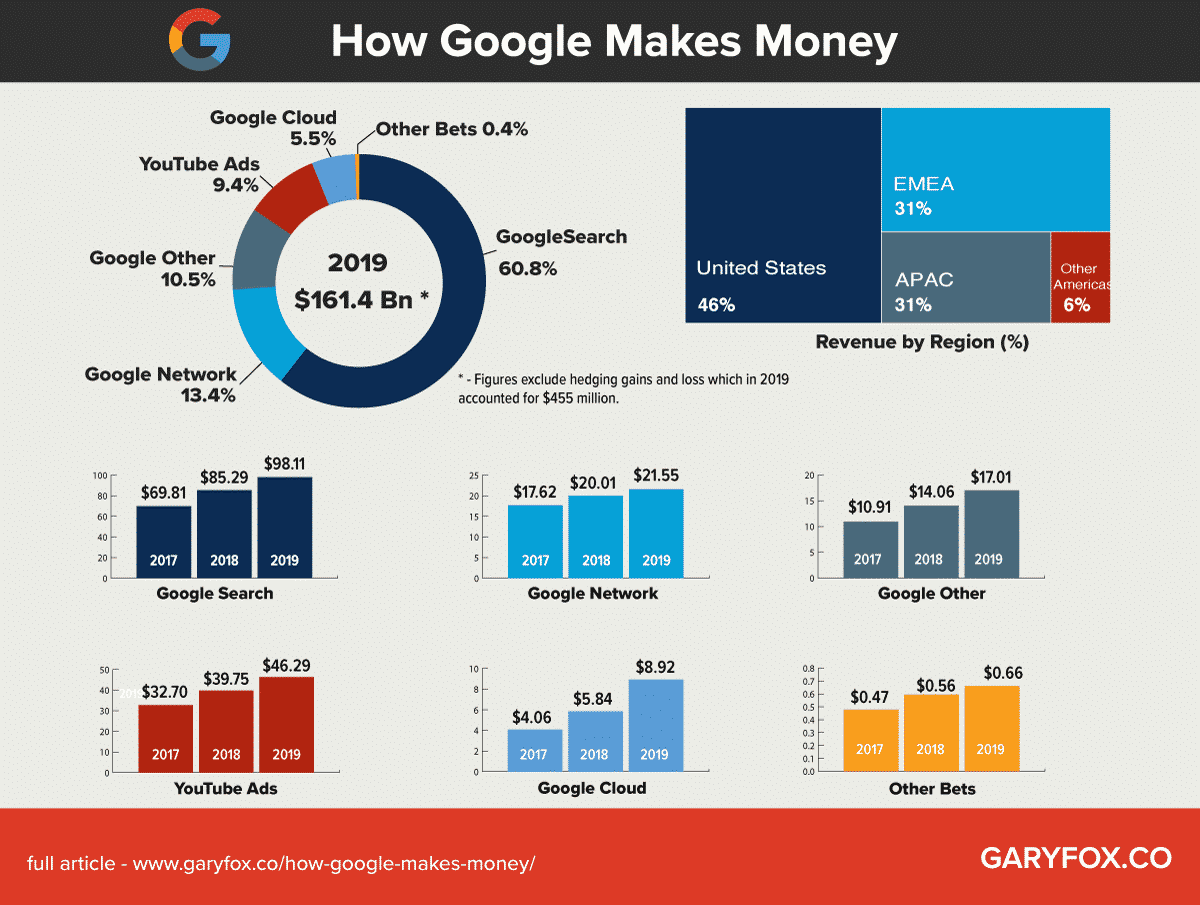
How does Google make money? Well the simple answer is Google makes the majority of its money from advertising.
In 2023, advertising accounted for approximately 77.4% of total revenue and is embedded within the broader Google Services category. The Google Cloud and Other Bets categories focus on non-advertising revenue streams, such as cloud services and experimental projects.
Table of Contents
What Is the Advertising Model Google Uses?

The hidden revenue business model of Google includes services like YouTube and Google Search. It revolves around offering free products to users while generating income from a separate source—primarily advertising.
Here’s how it works for Google:
- Free Services for Users: Google offers many of its key services, such as Search, YouTube, and Gmail, for free. Users do not pay directly to access these platforms.
- Revenue from Advertisers: Although users don’t pay to use these platforms, Google monetises the traffic by showing advertisements. Advertisers pay Google to display their ads to users who use Google Search or watch videos on YouTube. This creates value for advertisers, who can reach large, targeted audiences, and for Google, which profits from ad sales.
- Data-Driven Targeting: Google collects data about user behaviour—such as search queries or video preferences—which helps it deliver more relevant ads. This increases the likelihood that users will click on ads, boosting Google’s revenue from advertisers. This is often referred to as targeted advertising, where ads are more personalised based on user data.
This model is “hidden” because users aren’t charged for the services but instead pay indirectly by providing their attention and data, which Google leverages to generate revenue from advertisers.
In 2023, Google earned more than 75% of its revenue from advertising, demonstrating how crucial this hidden revenue model is to its business (Google Annual Report 2023).

What Are Google’s Main Consumer Products and Services
- Google Search: The most widely used search engine globally, providing web search capabilities.
- YouTube: A leading video-sharing platform offering content creation, sharing, and streaming services.
- Gmail: One of the most popular email services, offering free email accounts with advanced features like spam filtering.
- Google Maps: A mapping service providing directions, street views, and location-based services for users worldwide.
- Google Chrome: A web browser known for its speed and integration with Google’s other services.
- Google Drive: A cloud storage service that allows users to store files and collaborate in real-time.
- Google Photos: A photo storage and sharing service offering unlimited cloud storage for high-quality images and videos.
- Google Play Store: The digital distribution platform for apps, games, movies, and books on Android devices.
- Google Workspace: A suite of productivity tools, including Google Docs, Sheets, Slides, and Meet, aimed at both personal and business use.
- Google Assistant: A virtual assistant powered by AI, available on smartphones, smart home devices, and more.
- Pixel Devices: Google’s hardware line, including Pixel phones, tablets, and other consumer electronics.
- Nest: Smart home products, such as thermostats, security cameras, and smart speakers.
Who Are Google’s Main Competitors
Detailed below is a breakdown of Google’s main competitors by product and service segment:
- Search Engine
- Microsoft Bin
- Yahoo
- DuckDuckGo
- Baidu (China)
- Video Sharing/Streaming
- TikTok
- Facebook Watch
- Netflix (for premium video content)
- Vimeo
- Twitch (for live streaming)
- Email
- Microsoft Outlook
- Yahoo Mail
- Apple Mail
- Web Browser
- Mozilla Firefox
- Microsoft Edge
- Apple Safari
- Cloud Storage
- Dropbox
- Microsoft OneDrive
- Apple iCloud
- Amazon Web Services (AWS) S3
- Productivity Tools
- Microsoft Office 365
- Zoho Office Suite
- Apple iWork
- Advertising
- Meta (Facebook and Instagram Ads)
- Amazon Advertising
- Microsoft Ads (Bing Ads)
- TikTok Ads
- Cloud Computing
- Amazon Web Services (AWS)
- Microsoft Azure
- IBM Cloud
- Oracle Cloud
- Mobile Operating System
- Apple iOS
- HarmonyOS (Huawei)
- Smart Home Devices
- Amazon Alexa (Echo)
- Apple HomeKit
- Samsung SmartThings
- Virtual Assistant
- Apple Siri
- Amazon Alexa
- Microsoft Cortana
- Hardware
- Apple (iPhone, iPad)
- Samsung
- Huawei
- OnePlus
How Does Google Make Money?

Figures from 2023 indicate that Google processed approximately 3.8 trillion searches per year. This estimate is based on an average of over 100 billion searches per month, highlighting the immense scale and reach of Google’s search engine globally. In total, 77.3% of Google’s revenue in 2023 was generated from advertisements related to this search volume.

Advertising remained the main revenue-generating segment for Google in 2023.
What is Google’s Core Business?

Google has a core business model which is online advertising. However, it has acquired a number of companies over the years expanding its range of products and services e.g. FitBit.
In 2023, Google’s advertising segment generated $237.855 billion in revenue, representing a growth from the previous year’s $224.473 billion. The net income for Google in 2023 was $73.795 billion, indicating a substantial increase from $59.972 billion in 2022. This segment notably accounts for a significant portion of Alphabet’s overall business, representing approximately 77.3% of the total annual revenue, which amounted to $307.394 billion in 2023
If add-in Google Cloud then you reach 88% of what you could argue is its core business – tech, cloud services, infrastructure and streaming services like YouTube.
Google is pursuing products – expanding its range of hardware often through acquisitions such as Net and Fitbit. But will these payoff for Google int he long run?
The goal of our advertising products is to deliver relevant ads at just the right time and to give people useful commercial information, regardless of the device they’re using.
From Google 2023 10k Report
How Does Google Advertising Work?
Google splits their advertising into two categories:
- Performance advertising
- Brand advertising
Performance advertising
The rapid rise of ad blocking has dramatically changed the world on online advertising.
Over 18% of people who use the internet now use an ad blocker.
That means that 1 in 5 people might not see you ad which is money wasted.
That’s where performance advertising comes in.
Performance advertising lets our advertisers connect with users while driving measurable results.
Google
What Is Cost Per Click?
Performance-based advertising is when you pay only if a customer takes an action like clicking on a link.
Clicking links are tracked. Cost Per Click (CPC) is a measure for the average cost per click over a period of time an ad runs.
In Google AdWords, your final CPC will be determined by your ad’s Quality Score, your maximum CPC bid, and your Ad Rank.
Ad Rank is used to decide where the ad appears and what other ad formats will show with the ad.

Brand Advertising
Brand advertising helps enhance users’ awareness of and affinity with advertisers’ products and services,through videos, text, images, and other interactive ads that run across various devices.
Google
As Google highlights brand advertising is more about generating brand awareness. Typically advertisers pay for cost per impressions (CPM) and want to reach a much broader audience.
CPM bidding is the most common option for advertisers who are targeting the Display Network as this is the best option if you are trying to increase or improve your brand visibility.
How Google Makes Money
Google Advertising Model Explained
With over 77.4% of Google’s earnings coming from advertising, you’re probably wondering how it all works.
How Does Google Make Money From Advertisements?
To understand how Google makes money you need to understand the different types of advertising platforms. There are four main platforms advertisers use:
- Adwords
- Adsense
- Admob
- YouTube
1. Adwords

Nearly every you time you search on Google you will be presented with ads that dominate the top search results.
As explained before these ads are paid for by advertisers. Each time you click on an ad link Google earns money. How much just depends on how the value of the keyword and how much competition there is.
Google Shopping
You might be wondering how does Google make money from its shopping section?
Google Shopping allows consumers to search for, compare, and shop for physical products across different retailers who have paid to advertise their products. This is also known as a Comparison Shopping Engine (CSE). Google Shopping results show up as thumbnail images that display each product’s retailer and price.
As an advertiser, you can decide to set up a campaign for Google shopping using Adwords.

2. Adsense
A huge number of publishers on the internet make money by signing up to display Google ads.
After a publisher signs up to Adsense and adding the code to the website, Google will display targeted ads relevant to users’ previous searches, based on its proprietary algorithms.
3. Admob
Admob is where advertisers can sign up to display ads on apps. AdMob provides a way for Google to help app developers earn more money from their apps.
4. YouTube

In 2023, YouTube generated approximately $31.5 billion in revenue, which represents a 7.8% increase compared to the previous year.
This revenue accounted for about 10.25% of Google’s total revenue. Despite its significant revenue contribution, specific net income figures for YouTube are not typically disclosed separately by Alphabet, Google’s parent company.
So how does Google make money from YouTube?
- Searches: YouTube processes 3 billion searches per month, making it the second-largest search engine globally after Google.
- Video Uploads: Over 500 hours of video are uploaded to YouTube every minute, totaling more than 720,000 hours per day.
- Watch Time: Users watch 1 billion hours of video per day on YouTube, which is more than the combined daily viewing time on Netflix and Facebook. About 5 billion videos are watched every day. Netflix users collectively watch 400 million hours of video per day, a significant figure but much lower compared to YouTube’s 1 billion hours. Facebook sees about 100 million hours of video watched daily, which is much smaller compared to YouTube’s daily watch time.
YouTube Premium

YouTube Premium (formerly called YouTube Red), is a copy of the Spotify business model, offering both ad and ad-free streaming content.
In 2023, YouTube generated $31.5 billion in advertising revenue, contributing to Alphabet’s total revenue of $299.4 billion. This means that YouTube’s advertising revenue made up approximately 10.5% of Alphabet’s overall revenue, reflecting its continued importance as a key driver within Alphabet’s diverse revenue streams.
In other words, if people don’t subscribe Google gets money from advertisers paying to promote to viewers. On the other hand, it earns money when people subscribe and go ad-free.
Well, if you use YouTube you will have adverts before videos start of they are placed during the video. It all depends on the length of the video.
Advertisers pay for their videos to be placed on high volume videos that are related to their product or service.
Main Products and Services of Google
Advertising
Google’s advertising revenues remain its primary source of income, contributing approximately 77.4% of Alphabet’s total revenues. Here are the key components:
- Search Advertising: This is Google’s most significant revenue stream. In 2023, advertising on Google sites generated roughly $168 billion, which is a substantial portion of Alphabet’s total revenue.
- YouTube Advertising: YouTube ads generated about $29 billion in 2023. This includes revenue from ads played on videos, as well as subscription services like YouTube Premium and YouTube TV.
- Google Network Members’ properties: This includes revenue from AdSense, which helps publishers earn money by placing ads on their websites. In 2023, this segment brought in approximately $31 billion.
Google Cloud Platform (GCP)
- Cloud Services: GCP is a rapidly growing segment of Alphabet’s portfolio, contributing $25 billion in 2023. It offers computing resources, data storage, and various other services that compete directly with Amazon Web Services and Microsoft Azure.
Google Play and Hardware
- Google Play: This includes revenue from app sales, in-app purchases, and digital content subscriptions on Google Play. In 2023, it generated around $12 billion.
- Hardware: Sales from Google’s hardware products, such as Google Pixel phones, Google Home, and Nest devices, contributed approximately $8 billion to the revenue in 2023.
Other Bets
- Other Alphabet Businesses: Referred to as “Other Bets” within Alphabet’s financial reporting, this includes companies like Waymo (self-driving technology) and Verily (life sciences). Although these ventures are less profitable and still in early stages, they generated around $2 billion in 2023. Despite their current minimal financial impact, these investments are crucial for future growth and diversification.
Google’s Financial Strategy and Growth
Overall, Alphabet reported a total revenue of approximately $248 billion in 2023, with an operating income of $68 billion. The advertising segments collectively contribute a massive share, underscoring Google’s dominance in digital advertising. Meanwhile, Google Cloud and Play Store represent growing segments with potential for greater revenue contributions in the future.
Notes on Google’s Revenue
Alphabet is a collection of businesses — the largest of which is Google. All non-Google businesses collectively are reported as ‘Other Bets’.
| Google Search & other | Google Network | Google Other |
| Google Ads | AdMob and AdSense | Google Play (sales of apps and in-app purchases) Google Nest Home Products PixelBooks Pixel Phones Other devices YouTube Premium & YouTube TV |
| Google Search & other | Google Network | Google Other |
| Google Ads | AdMob and AdSense | Google Play (sales of apps and in-app purchases Google Nest |
Google Hardware Business

Google faces stiff competition in the hardware market. Would you bet on Google winning at hardware?
It seems a strange question, but the once pure digital company is diversifying into hardware at a time when others are expanding into digital services e.g. Apple business model.
With China and Asia gaining ground with new hardware brands competition is only going to get tougher.
Google doesn’t do retail or even etail that well, it’s not in its DNA. Compare the Google online shop to Apple.
One is brilliantly designed the other looks like a market more than a focus on individual brands. The Nest branding and value proposition is lost amongst the Google branding. See value proposition examples to get more of an idea on this.
Google doesn’t seem to have got the same focus on design and branding yet. Over the years its interfaces have always been a bit clunky compare to Microsoft and Apple.
I appreciate that hardcore fans of Android and Google might disagree but the user experience is becoming more important. Even Google seems to recognize that.
It has progressively revamped the user interface for a number of its services.
Google Pixel
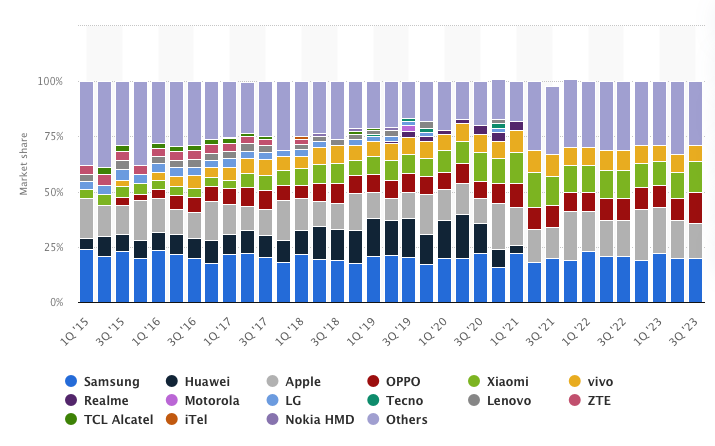
With the Google Pixel, it is going up against an intensely competitive market with strong players like Apple (iPhone) and Samsung (Galaxy).
In fact, Google Pixel fits into the ‘Others’ part of the global market share for smartphones.
Google Nest Products

Google acquired Nest Labs, now Google Nest, in 2014 for $3.2 billion. It seemed at the time that with Google’s wealth and expertise in online advertising, technology a perfect match.
But figures show disappointing results.
I’ve covered a lot so far in this post on how does Google make money. But, there are a few more surprising details to come.
Google Bets – the Future of Google?
What Is Google’s Bets?
Other Bets are Google’s investments in new and emerging technologies that might be important for its revenue and growth in the future. In 2023, other bets accounted for 0.4% of Google’s annual revenue.
Some examples of Google’s other bets
Google’s Other Bets segment includes a collection of ventures that aim to leverage cutting-edge technology to solve large-scale problems across industries. These ventures are typically at various stages of development and operate independently, with some already generating revenue. The main focus areas of Other Bets include healthcare, internet services, and advanced technology solutions such as autonomous driving.
Key Points on Other Best from the Google 2023 Annual Report:
- Revenue: In 2023, Other Bets generated $1.53 billion in revenue, an increase from $1.07 billion in 2022 .
- Losses: Despite the revenue growth, the operating loss for Other Bets was $4.1 billion in 2023, an improvement compared to the $4.6 billion loss in 2022 .
- Main Ventures:
- Waymo: Focuses on autonomous driving technology and is one of the leading initiatives within Other Bets.
- Verily: A health tech company that develops tools and solutions to improve healthcare outcomes. It generates significant revenue from its healthcare-related services.
- Independent Structure: Each of these ventures operates as an independent entity, with its own board and, in some cases, external investors .
- Risk and Uncertainty: Google acknowledges that many of these ventures are in the early stages of development, which involves considerable uncertainty. The company continues to invest in these areas with the goal of turning them into successful businesses in the future .
What Are Examples of Google’s Other Bets?
- Waymo is one of the most advanced autonomous vehicle technology firms. The autonomous vehicle market is predicted to be worth $556.67 billion by 2026. No surprise that Google wants to be positioned to seize a slice of that market. Note: Predictions for the value of the global autonomous vehicle market vary, but they consistently point toward substantial growth driven by advancements in AI, sensors, and connectivity. Here are some different estimates:
- Grand View Research estimates the market will grow from $53.71 billion in 2023 to $214.32 billion by 2030, with a compound annual growth rate (CAGR) of 21.9% during the forecast period (Grand View Research).
- Allied Market Research projects the market will reach $448.6 billion by 2035, with a CAGR of 22.2% between 2025 and 2035. This growth will be driven by investments in smart infrastructure and autonomous technology for both consumer and commercial use (Allied Market Research).
- Fortune Business Insights forecasts the market to grow from $1.92 trillion in 2023 to $13.63 trillion by 2030, driven by significant adoption in regions like Asia-Pacific, where congestion and demand for efficient transport solutions are high (Grand View Research).
- Loon is a company whose goal is to bring connectivity to remote parts of the world where cell towers would be too expensive to build. Loon uses solar-powered balloons that float over a remote region and offer network access via onboard networking technologies.
- Wing is an automated drone delivery service. It provides commercial air delivery services in Canberra, Australia, and Helsinki, Finland as well as certain parts of the US. It already has several commercial partners in the US including Walgreens Boots Alliance Inc and FedEx Corp.
- Verily is a life science technology unit that includes research into wearables and healthcare products/services. It already partners with several pharmaceuticals for research on such projects as surgical robots and retina scan technology.
- Sidewalk Labs aims to combine forward-thinking urban design and cutting-edge technology to radically improve urban life.
Summary of How Google Makes Money
Google’s core business model is still its ad business. Google has expanded its portfolio through a number of acquisitions and investments, but many of these ventures have yet to achieve the same scale as this tech giant.


