The unique Ikea business model changed how people furnish their homes by offering affordable, stylish, and functional products they assemble.
The Swedish furniture giant IKEA is now a global brand that has developed its unique shopping experience.
I’ll walk you through the IKEA business model and show how the company re-engineered the value proposition to disrupt the furniture market.
Table of Contents
How Does IKEA’s Business Work
IKEA operates a multinational furniture store network that offers a wide range of well-designed, functional, and affordable home furnishing products.
The company’s business model is based on self-service (see the self-service business model pattern) and flat-packing, allowing customers to browse, select, and transport their purchases.

IKEA designs its products, works with suppliers to manufacture them, and then sells them through its large, warehouse-style stores and online platforms.
By controlling the entire value chain, from design to retail, IKEA keeps costs low and passes the savings on to its customers.
Key Facts About Ikea
Ikea
Ingvar Kamprad
1943
1943
Jesper Brodin
Leiden, Netherlands
219,000 (2023)
IKEA is privately held
47 billion euros (2023)
1.507 billion euros (2023)
IKEA is privately held
What does IKEA stand for?
An idea turned into a name! IKEA is named after the initials of founder Ingvar Kamprad, Elmtaryd, the farm on which he grew up, and the nearby village Agunnaryd.
Useful Links for Ikea









A Brief History of Ikea

IKEA was founded in 1943 by Ingvar Kamprad, a 17-year-old Swedish entrepreneur.
Initially, the company sold various products through mail-order catalogues, including pens, wallets, and picture frames.
In 1948, furniture was introduced into the product line, and it quickly became the company’s primary focus. IKEA’s innovative flat-pack design, introduced in the 1950s, revolutionized the furniture industry by making transportation and storage more efficient.
How Ikea Changed the Value Proposition
The furniture market at the time consisted of many manufacturers who produced and shipped furniture to stores and then sold it to customers.
In the early days of IKEA, most furniture was pre-assembled, making it bulky and expensive to store and transport. IKEA saw an opportunity to cater to low-income customers who wanted quality furniture at affordable prices.
Adopting a flat-pack design significantly reduced storage and transportation costs, allowing them to offer lower prices without sacrificing quality.
From a Blue Ocean Strategy perspective, IKEA re-engineered value by streamlining production and logistics, creating a new market space prioritising affordability and convenience.
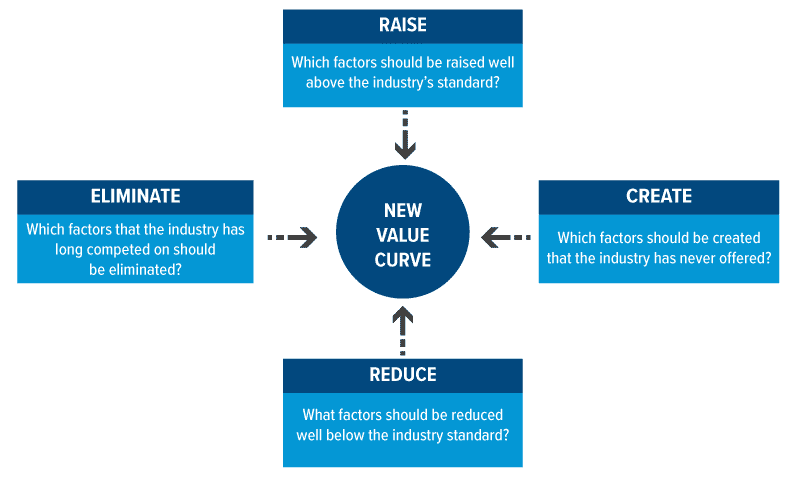
Key milestones in IKEA’s history include:
- 1943: Ingvar Kamprad founds IKEA as a mail-order business.
- 1948: Furniture is added to IKEA’s product line.
- 1953: The first IKEA showroom opens in Almhult, Sweden.
- 1956: The flat-pack design is introduced, allowing customers to assemble furniture.
- 1958: The first IKEA store opens in Almhult, Sweden.
- 1960s-1970s: IKEA expands internationally, opening stores in Norway, Denmark, Switzerland, and Germany.
- 1985: IKEA begins sourcing from suppliers in Poland, marking the start of its global sourcing strategy.
- 2000: The company launches its online store, expanding its reach beyond physical locations.
- 2012: IKEA introduces its People & Planet Positive strategy, focusing on sustainability and social responsibility.
- 2021: IKEA announces its commitment to becoming climate-positive by 2030.
Throughout its history, IKEA has remained committed to its core values of affordability, sustainability, and democratic design.
Who owns IKEA?
IKEA is owned by a complex structure of companies and foundations. The ultimate parent company of the IKEA Group is Inter IKEA Holding B.V., a Dutch company owned by the Interogo Foundation, a Liechtenstein-based foundation.
The Interogo Foundation is controlled by the Kamprad family, ensuring that IKEA remains true to its founding principles and long-term vision.
IKEA is not publicly traded on any stock exchange, and its financial information is not widely disclosed.
Ikea Mission statement
“Our vision is to create a better everyday life for the many people. Our business idea supports this vision by offering a wide range of well-designed, functional home furnishing products at prices so low that as many people as possible will be able to afford them.”
How IKEA works
The IKEA business model is built around controlling the entire value chain.
From product design and sourcing to manufacturing and retail, IKEA’s in-house designers create stylish, functional, and easy-to-produce products. The company works closely with suppliers to ensure cost efficiency and adherence to strict quality and sustainability standards.
One key aspect of the IKEA business model is its self-service and flat-packing approach. Customers browse the store, select their products, and then collect the flat-packed items from the warehouse section.
This allows IKEA to save on labour costs and lets customers transport their purchases quickly. By involving customers in the process, IKEA can offer lower prices while maintaining a satisfying shopping experience.
IKEA’s stores are strategically designed to maximize customer engagement and sales. The stores feature a showroom area where products are displayed in realistic room settings, inspiring customers and showcasing the versatility of IKEA’s products. Ikea pays particular attention to understanding the customer journey.
Customers are guided through a predetermined path that exposes them to the entire product range, encouraging impulse purchases. The stores also include restaurants and childcare facilities, making the shopping experience more convenient and enjoyable for families.
In recent years, IKEA has also focused on expanding its online presence, allowing customers to browse and purchase products through its website and mobile app.
The company has invested in digital technologies to enhance the customer experience, such as augmented reality tools that enable customers to visualize how furniture would look in their homes.
The Revenue Model of IKEA
The IKEA business model makes money through several key revenue streams:
- Product sales: The primary source of revenue for IKEA comes from the sale of its home furnishing products, including furniture, accessories, and home décor items.
- Food and beverage sales: IKEA’s in-store restaurants and food markets contribute to the company’s revenue by offering affordable meals and Swedish specialities.
- Service sales: IKEA generates revenue through services such as home delivery, assembly, and installation, which are offered to customers for an additional fee.
- Franchise fees: IKEA operates some of its stores through franchisees, who pay the company a franchise fee for the right to use its brand and business model.
Ikea Business Model Patterns
For more details on how firms harness technologies and reduce costs using self-service mechanisms, see the self-service business model pattern.
See the franchising business model pattern for more details.

See the ecommerce business model pattern for more details.

What is unique about the Ikea business model?
Key Features of IKEA’s Business model
- Self-service and flat-packing approach to reduce costs
- In-house product design and global sourcing for cost-efficiency
- Large, warehouse-style stores with showrooms for customer engagement
- Commitment to sustainability and social responsibility – see the Ikea Circular Economy
The Ikea Business Model
I’ve broken down the Ikea business model and put it into the business model canvas.

What is the business model of Ikea furniture company? The Ikea business model is a mix of retail, e-commerce and self-service business model patterns. Read on to find out more.

Customer Segments
The IKEA business model caters to a wide range of customer segments. The company’s affordable, stylish, and functional products appeal to various demographics, making IKEA a popular choice for many. IKEA’s customer segments include:

Value Propositions
The IKEA business model offers a compelling value proposition to its customers. The company’s unique blend of affordability, design, and functionality sets it apart from competitors and attracts a loyal customer base. IKEA’s main value propositions include:

Channels
The IKEA business model utilizes various channels to reach and serve its customers. The company’s omnichannel approach ensures customers can engage with the brand through multiple touchpoints. IKEA’s main channels include:

Customer Relationships
IKEA’s business model emphasizes building strong, long-lasting relationships with its customers. The company focuses on creating a positive and memorable shopping experience that encourages customer loyalty and advocacy. IKEA’s customer relationships are characterized by:

Key Activities
IKEA’s business model revolves around a set of key activities that drive its value creation and delivery. These activities ensure that the company consistently meets customer needs and maintains its competitive edge. IKEA’s key activities include:

Key Resources
The IKEA business model relies on a set of key resources to create and deliver value to its customers. These resources form the foundation of the company’s competitive advantage and enable its global operations. IKEA’s key resources include:

Key Partners
The IKEA’ business model involves collaboration with a network of key partners. These partnerships enable the company to optimize its operations, access specialized expertise, and enhance its value proposition. IKEA’s key partners include:

Revenue Streams
The IKEA business model generates revenue through several key streams. The company’s diversified income sources contribute to its financial stability and growth. IKEA’s main revenue streams include:

Cost Structure
IKEA’s business model incurs various costs to maintain its operations and deliver value to customers. The company must manage these costs effectively to ensure profitability and long-term sustainability. IKEA’s main cost components include:
The Future of the IKEA Business Model
As IKEA looks to the future, the company will continue to invest in digital technologies, such as augmented reality and artificial intelligence, to enhance the customer experience and streamline operations.
This will enable IKEA to offer more personalized product recommendations, improve its e-commerce capabilities, as well as optimize its supply chain.
Sustainability will remain a key focus for IKEA as it sets ambitious goals to become climate-positive and fully circular by 2030. This will involve increasing the use of renewable energy, developing more eco-friendly products, and implementing closed-loop manufacturing processes. By prioritizing sustainability, IKEA can reduce its environmental impact and appeal to increasingly environmentally conscious consumers.
IKEA will also likely expand its services, such as home delivery, assembly, and furniture rental, to cater to the growing demand for convenience and flexibility. As urbanization continues and living spaces become smaller, IKEA may focus on developing more space-saving and multifunctional furniture solutions.
Additionally, IKEA may explore new partnerships and collaborations to enter new markets, diversify its product range, and tap into emerging trends. For example, the company could collaborate with technology firms to develop smart home solutions or partner with fashion brands to create limited-edition collections.
Adapting the IKEA business model to the evolving needs of its customers and the broader societal and environmental challenges, IKEA can maintain its position as a global leader in the home furnishings industry while continuing to create value for all its stakeholders.


