The LinkedIn business model is a platform-based business that has become the world’s largest professional networking site.
LinkedIn transformed how individuals connect, job seekers find opportunities, and businesses showcase their brands.
With over 900 million members in more than 200 countries and territories, LinkedIn is an indispensable tool for professionals across all industries.
I’ll examine the business model that has propelled LinkedIn’s success.
Table of Contents
How Does LinkedIn’s Business Work
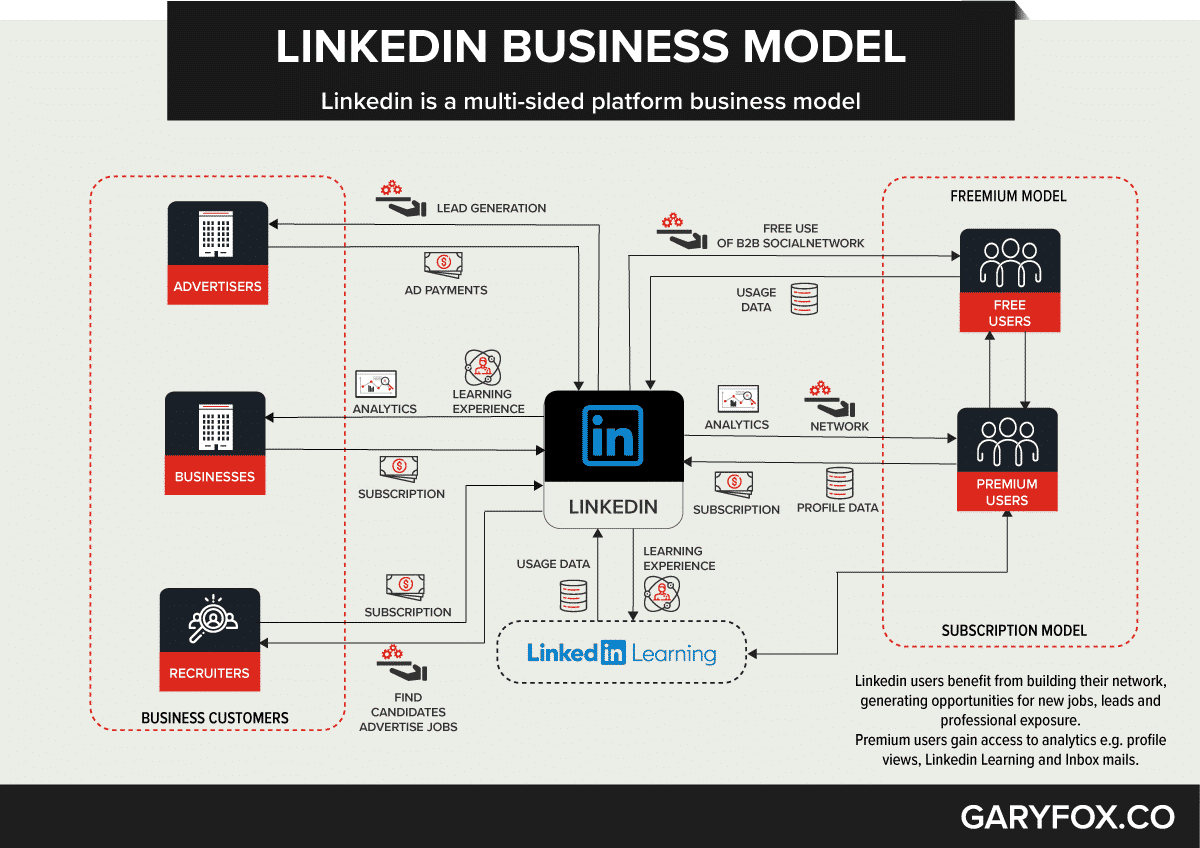
The LinkedIn business model is based on a multi-sided platform which connects professionals, job seekers, and businesses.
The business model revolves around providing valuable tools and services to its members and attracting advertisers and recruiters.
LinkedIn generates revenue by leveraging vast amounts of user-generated data and offering targeted advertising solutions and premium subscription services.
LinkedIn Key Facts
May 5, 2003
2002
Ryan Roslansky
Sunnyvale, California, USA
19,400
part of Microsoft
$17.45 billion (2023)
$4.1 billion (2023)
part of Microsoft
Useful Links About LinkedIn









A Brief History of LinkedIn
LinkedIn’s journey began in 2002 when co-founders Reid Hoffman, Allen Blue, Konstantin Guericke, Eric Ly, and Jean-Luc Vaillant launched the platform. The company quickly gained traction among professionals seeking to network and advance their careers.

Key milestones and dates of LinkedIn:
- 2003: LinkedIn officially launches, gaining 4,500 members in the first month
- 2004: LinkedIn reaches 1 million members
- 2006: LinkedIn introduces public profiles, allowing users to create a professional online presence
- 2007: LinkedIn launches its first premium subscription service, LinkedIn Jobs
- 2008: LinkedIn opens its platform to developers, enabling third-party applications
- 2010: LinkedIn expands internationally, launching in French and Spanish
- 2011: LinkedIn goes public on the New York Stock Exchange
- 2012: LinkedIn acquires SlideShare, a platform for sharing professional content
- 2016: Microsoft acquires LinkedIn for $26.2 billion
- 2017: LinkedIn reaches 500 million members
- 2018: LinkedIn introduces its own video platform, LinkedIn Video
- 2021: LinkedIn surpasses 900 million members worldwide
Who Owns LinkedIn
LinkedIn is owned by Microsoft Corporation, which acquired the company in December 2016 for $26.2 billion.
The acquisition was driven by Microsoft’s desire to integrate LinkedIn’s vast professional network and data into its existing product ecosystem, such as Office 365 and Dynamics 365.
Despite the acquisition, LinkedIn continues to operate as a separate business unit within Microsoft, maintaining its distinct brand identity and platform.
LinkedIn Mission Statement
LinkedIn’s mission statement is “To connect the world’s professionals to make them more productive and successful.”
How LinkedIn Works
The LinkedIn business model is based on a platform based social network that harness the freemium business model pattern.

The platform allows users to create profiles showcasing their professional experience, skills, and accomplishments.
Members can connect with colleagues, industry peers, and potential clients, fostering valuable relationships and facilitating knowledge sharing.
For job seekers, LinkedIn is a powerful tool for discovering new opportunities, applying for positions, and showcasing their qualifications to potential employers.
Employers, in turn, can leverage LinkedIn’s extensive user database to identify and recruit top talent for their organizations.
LinkedIn also provides various tools and features to help businesses establish their brand presence, engage with their target audience, and generate leads.
Companies can create dedicated pages to showcase their products, services, and company culture and share updates and thought leadership content with their followers.
To monetise its platform, LinkedIn offers several premium subscription services, such as LinkedIn Premium, Sales Navigator, and Recruiter.
These services provide advanced features and insights to help professionals and businesses achieve their goals more effectively.
Additionally, LinkedIn generates revenue through targeted advertising solutions, allowing companies to reach specific audiences based on job title, industry, company size, and other demographic factors.
How LinkedIn Makes Money

The Revenue Model of LinkedIn
The LinkedIn revenue model consists of three main pillars:
- Talent Solutions: LinkedIn’s most significant revenue stream, which includes job postings, recruitment tools, and premium subscriptions for recruiters and employers.
- Marketing Solutions: Encompasses sponsored content, display advertising, and sponsored InMail, enabling businesses to reach and engage with their target audience on the platform.
- Premium Subscriptions: This option offers individual members premium features and insights, such as advanced search capabilities, InMail credits, and access to online learning courses through LinkedIn Learning.

LinkedIn Key Financial Data
1. Revenue Growth: LinkedIn’s total revenue for the fiscal year 2023 was reported at $17.45 billion, marking an increase of 25% from the previous year’s revenue of $13.96 billion. This substantial growth highlights LinkedIn’s expanding influence in the professional networking space.
2. Market Expansion and User Engagement: By the end of 2023, LinkedIn had 900 million registered users.
LinkedIn has reported a 22% increase in sessions year-over-year, reflecting enhanced user engagement and content interaction.
The platform’s active job postings have also seen a significant uptick, with a 31% increase compared to the previous year. This indicates a solid job market and increased reliance on LinkedIn for talent acquisition.
3. Strategic Initiatives and Product Development: LinkedIn has heavily invested in AI and machine learning technologies to drive user engagement and streamline job matching processes.
In 2023, LinkedIn launched AI-driven features like “AI Articles,” contributing to a 28% increase in content creation and sharing activities.
The platform’s revenue from Learning Solutions grew by 19%, underscoring the growing demand for continuous learning and professional development through online courses.
4. Financial Viability: LinkedIn’s operating income in 2023 was $4.1 billion, representing an operating margin of approximately 23.5%.
Microsoft’s overall investment in AI has further enhanced LinkedIn’s product offerings, leading to better user experience and increased monetization opportunities.
Key Features of the LinkedIn Business Model
- A multi-sided platform connecting professionals, job seekers, and businesses
- Extensive user-generated data enabling targeted advertising and premium services
- The freemium model offers basic features for free and premium features for a subscription fee
- Diversified revenue streams, including Talent Solutions, Marketing Solutions, and Premium Subscriptions
LinkedIn Business Model Patterns
The LinkedIn Business Model Canvas

The LinkedIn Business Model

LinkedIn Customer Segments
The LinkedIn business model includes the following as key customer segments:
- Professionals: Individuals seeking to network, showcase skills, and advance careers
- Job seekers: People actively searching for new job opportunities
- Recruiters: Professionals looking to find and hire top talent
- Businesses: Companies aiming to promote their brand and connect with customers
- Advertisers: Organizations looking to reach a targeted professional audience

LinkedIn Value Propositions
The Linkedin business model focuses on the following value propositions to meet the needs of its various customer segments:
- Professional networking: LinkedIn enables professionals to connect with colleagues, industry peers, and potential business partners, fostering valuable relationships and facilitating knowledge sharing.
- Career advancement: The platform provides tools and resources for professionals to showcase their skills, experience, and accomplishments, increasing visibility and opportunities for career growth.
- Talent acquisition: LinkedIn offers recruiters and businesses access to a vast pool of qualified candidates, streamlining the hiring process and improving the quality of hires.
- Brand promotion: Companies can establish a strong brand presence on LinkedIn, engaging with their target audience and showcasing their products, services, and thought leadership.
- Targeted advertising: Advertisers can reach a highly-targeted professional audience based on job title, industry, company size, and other demographic factors, ensuring their messages reach the right people.

LinkedIn Channels
The Linkedin business model uses the following channels to reach and engage with its customers:
- Website: The main platform for user interaction and content sharing
- Mobile app: Enables users to access LinkedIn on-the-go
- Email notifications: Keeps users informed about relevant activity and updates
- LinkedIn Learning: Offers online courses for professional development
- LinkedIn Events: Facilitates virtual and in-person networking events

LinkedIn Customer Relationships
The Linkedin business model uses aims to develop and maintain its customer relationships using the following methods:
- Self-service: Users can create profiles, connect, and interact independently
- Automated services: Personalized recommendations and notifications keep users engaged
- Community building: LinkedIn Groups foster discussions and knowledge sharing
- Customer support: Assistance is available for technical and account-related issues

LinkedIn Key Activities
The Linkedin business model focuses on the key activities essential to deliver value to its customers, generate revenue, and maintain its competitive position in the market:
- Platform development: Continuously enhancing and updating the LinkedIn platform
- Data management: Collecting, analyzing, and leveraging user data for improved services
- Content moderation: Ensuring a safe, professional, and trustworthy environment
- Marketing and sales: Promoting LinkedIn’s services to users and potential customers
- Customer support: Assisting users with technical and account-related issues

LinkedIn Key Resources
The Linkedin business model harness the following as key resources:
- Intellectual property: Proprietary algorithms, data, and technology platforms
- Human capital: Skilled workforce, including engineers, data scientists, and marketers
- User data: Extensive database of professional profiles and interactions
- Brand: Strong reputation and trust among professionals worldwide

LinkedIn Key Partners
The LinkedIn business model relies on a diverse network of key partners for specialized expertise, resources, and capabilities to enable the delivery of its value propositions:
- Technology providers: Companies supplying software, hardware, and cloud services
- Content partners: Publishers and thought leaders providing valuable insights
- Integration partners: Apps and services that connect with LinkedIn’s platform
- Advertising partners: Agencies and ad networks that help marketers reach LinkedIn’s audience
- Educational institutions: Universities and learning providers offering content for LinkedIn Learning

Linkedin Revenue Streams
The LinkedIn business model generates the following revenue streams:
- Talent Solutions: Job postings, recruitment tools, and premium subscriptions for recruiters
- Marketing Solutions: Sponsored content, display advertising, and sponsored InMail
- Premium Subscriptions: Upgraded features and insights for individual members
- LinkedIn Learning: Subscription-based access to online learning courses

Linkedin Cost Structure
The LinkedIn business model incurs the following as the main costs associated with its operations:
- Personnel expenses: Salaries, benefits, and bonuses for LinkedIn’s workforce
- Technology costs: Expenses related to software, hardware, and cloud services
- Marketing and sales: Costs associated with promoting LinkedIn’s services and acquiring customers
- Research and development: Investments in innovation and new product development
- General and administrative: Expenses for office space, legal fees, and other overhead costs
Top Linkedin Competitors
- Facebook: Social media giant with a growing focus on professional networking
- Xing: European professional networking platform
- Viadeo: Professional networking platform popular in France and China
- Glassdoor: Job and recruiting site featuring company reviews and salary data
- Indeed: Job search engine and aggregator
- Monster: Online job board and career management platform
- CareerBuilder: Job search and recruitment platform
- ZipRecruiter: AI-powered job matching and distribution platform
- Upwork: Freelance marketplace connecting businesses with remote talent
- Twitter: Social media platform increasingly used for professional networking and job searching
The Future of the LinkedIn Business Model
The LinkedIn business model is well-positioned to capitalize on the growing importance of professional networking and digital talent acquisition. However, the company must navigate challenges posed by increasing competition, evolving user preferences, and regulatory pressures.
LinkedIn should leverage advanced technologies like AI and machine learning to provide users with more personalized and valuable experiences. Expanding its offering in the online learning space, particularly in light of the growing demand for upskilling and reskilling, could further strengthen LinkedIn’s value proposition.
Additionally, LinkedIn must protect user data and ensure a safe, trustworthy environment for professional interactions. As privacy concerns and regulations evolve, the company must adapt its practices to maintain user trust and comply with legal requirements.


