The Nintendo business model is a great case study in how a company can innovate by reimagining its value proposition.
The Blue Ocean Strategy provides a framework for examining a market’s current offers and then systematically transforming them to create a new, unique value proposition.
I’ve provided a guide and some templates on the blue ocean strategy you can use for your business.
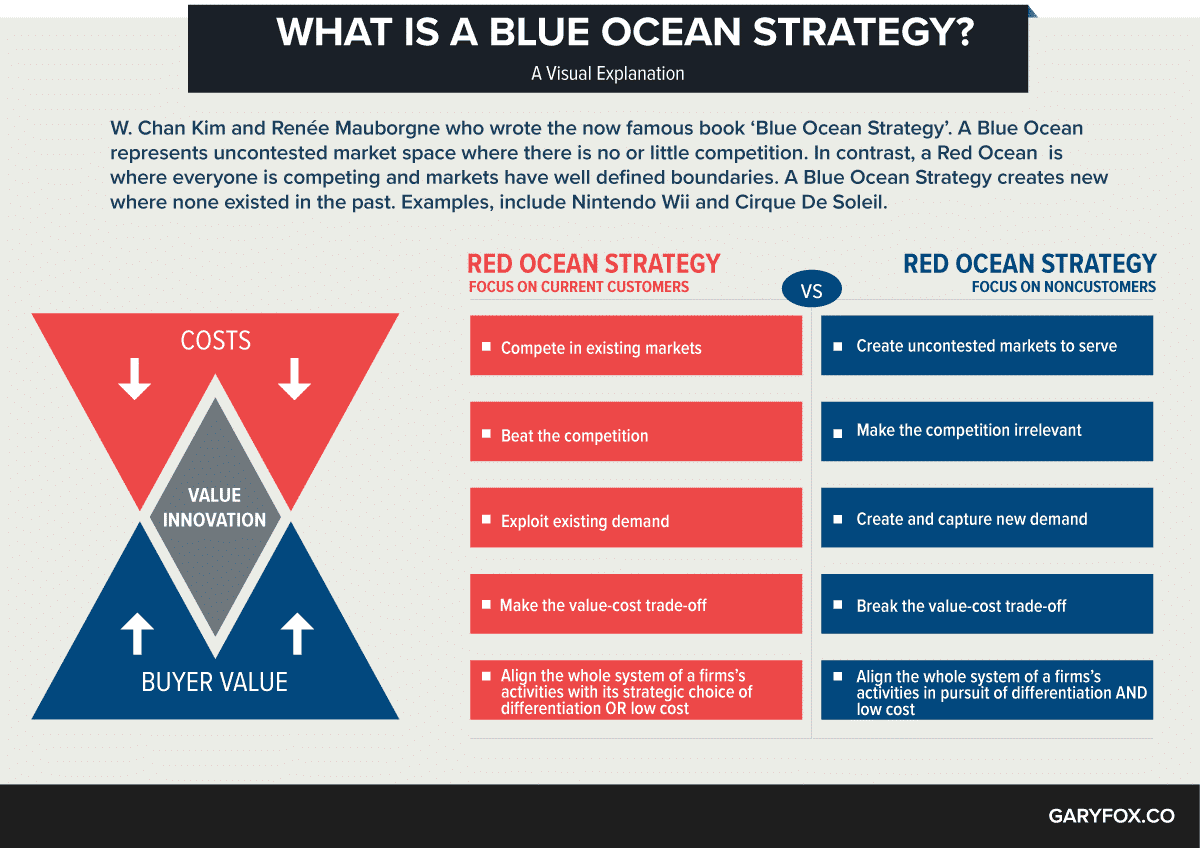
Table of Contents
How Does Nintendo’s Business Work?
Nintendo is a Japanese multinational consumer electronics and video game company that develops, manufactures, and markets video game consoles, software, and accessories.
It creates innovative gaming hardware like the Switch and popular first-party game franchises such as Mario, Zelda, and Pokamon. Nintendo sells consoles and games globally through retailers and its eShop digital storefront.
Key Features of The Nintendo Business Model
- Develops innovative gaming hardware (Switch, DS, etc.)
- Creates popular first-party franchises (Mario, Zelda, etc.)
- Offers digital distribution and services (eShop, Nintendo Online)
- Pursues licensing/merchandising of IP
Key Facts About Nintendo
Nintendo
Fusajiro Yamauchi
September 23, 1889
1889
Shuntaro Furukawa
Kyoto, Japan
7,498 (as of March 31, 2023)
NTDOY
1,733.8 billion yen ($13.2 billion) for fiscal year ended March 31, 2023
432.7 billion yen ($3.3 billion) for fiscal year ended March 31, 2023
$47.47 billion (as of August 2023)
Useful Links For Nintendo









A Brief History of Nintendo
Nintendo was founded in 1889 as a playing card company in Kyoto, Japan.
In the 1970s, it expanded into electronic games and launched the Color TV-Game home consoles.
Nintendo entered the global video game market with arcade games in the early 1980s followed by the Famicom/NES home console in 1983.
The NES revitalized the industry, making Nintendo a gaming icon with franchises like Super Mario Bros.
Key milestones:
- 1989: Game Boy portable system launched
- 1990: Super Famicom/SNES released
- 1996: Nintendo 64 introduced analog stick and 3D gaming
- 1996: Pokémon sparks global phenomenon
- 2001: GameCube and Game Boy Advance released
- 2004: Nintendo DS features dual screens and touch
- 2006: Wii revolutionizes motion controls
- 2011: 3DS brings stereoscopic 3D
- 2012: Wii U gamepad offers off-TV play
- 2017: Switch combines portable and TV gaming
Who owns Nintendo?
Nintendo Co., Ltd. is a publicly traded company on the Tokyo Stock Exchange.
As of August 2023, the top shareholders are:
- The Master Trust Bank of Japan (12.7%)
- JP Morgan Chase Bank (7.7%)
- Custody Bank of Japan (5.6%)
- State Street Bank and Trust Company (2.7%).
- Individuals in the Yamauchi family, descendants of the company’s founders, hold over 10% of shares.
The Nintendo Mission Statement
“At Nintendo we are proud to be working for the leading company in our industry. We are strongly committed to producing and marketing the best products and support services available. We believe it is essential not only to provide products of the highest quality, but to treat every customer with attention, consideration and respect. By listening closely to our customers, we constantly improve our products and services.”
(Official Nintendo mission statement)
How the Nintendo Business Model Works
The Nintendo business model focuses on developing innovative video game hardware and software.
It creates console systems with unique features to stand out in the market, such as the Switch’s hybrid design for portable and TV play.
Nintendo then produces high-quality first-party games, often based on popular franchises like Mario and Zelda, to drive demand for its gaming systems.
Nintendo pursues a “blue ocean” strategy targeting untapped demographics beyond core gamers. It makes consoles user-friendly and bundles them with accessible yet engaging games.
Many of Nintendo’s series, such as Wii Sports, Pokamon, and Animal Crossing, have become cultural touchstones appealing to all age groups.
In addition to its hardware and retail game sales, Nintendo offers digital services for downloading games, accessing classic titles, and playing online.
These include the eShop storefront and subscription business model for the Nintendo Switch Online. It also generates revenue through licensing characters for merchandise, movies, theme parks, etc. By leveraging its renowned IP across entertainment, Nintendo maintains a strong brand that supports its gaming ecosystem.

The Revenue Model of Nintendo
Here is a table summarising Nintendo’s revenue and profit over the last 10 years:
| Year | Revenue (USD Billion) | Net Profit (USD Billion) |
|---|---|---|
| 2024 | 11.50 | 3.90 |
| 2023 | 11.97 | 4.91 |
| 2022 | 12.62 | 4.33 |
| 2021 | 14.87 | 4.77 |
| 2020 | 16.02 | 4.80 |
| 2019 | 11.25 | 2.58 |
| 2018 | 10.84 | 2.53 |
| 2017 | 9.20 | 1.61 |
| 2016 | 3.53 | 0.26 |
| 2015 | 4.41 | 0.25 |
Nintendo makes money in several key ways:
- Sales of gaming hardware (Switch, 3DS, etc.)
- Sales of first-party game software
- Revenue from digital game sales, DLC, and microtransactions
- Nintendo Switch Online subscription fees
- Licensing of characters/franchises for merchandise, media, attractions, etc.
Nintendo 2024 Revenue By Category
1. Hardware
- Revenue: ¥511.9 billion (~$3.53 billion USD)
- This category includes sales of Nintendo consoles like the Switch, which continues to be the company’s main hardware product.
2. Software
- Revenue: ¥675.4 billion (~$4.66 billion USD)
- This covers video game sales, including both physical and digital downloads. Major titles in 2024 likely included popular franchise games like The Legend of Zelda and Super Mario.
3. Mobile and IP-related Income
- Revenue: ¥81.8 billion (~$564 million USD)
- Includes revenue from mobile games like Mario Kart Tour and income from intellectual property licensing, such as the Super Mario movie and theme park collaborations.
4. Others (e.g., accessories, merchandise)
- Revenue: ¥184.1 billion (~$1.27 billion USD)
- This category includes revenue from accessories (controllers, etc.), Amiibo figurines, and other merchandising ventures.
Nintendo Business Model
I’ve detailed the main points of the Nintendo business model in the business model canvas below.

The nine sections of the Nintendo business model are detailed below.
The Nintendo Business Model

Nintendo Customer Segments
The Nintendo business model targets a variety of key customer segments. The main customer segments:

Nintendo Value Propositions
Nintendo’s business model delivers compelling value propositions to customers. The main value propositions:

Nintendo Channels
Nintendo’s business model utilizes multiple channels to reach and serve customers. The main channels:

Nintendo Customer Relationships
Nintendo’s business model prioritizes positive customer relationships in several key ways. The primary customer relationships:

Nintendo Key Activities
Nintendo’s business model requires excellence in key activities:

Nintendo Key Resources
The Nintendo business model relies on several key resources:

Nintendo Key Partners
The Nintendo business model involves collaboration with key partners:

Nintendo Revenue Streams
Nintendo’s business model generates revenue through several important streams:

Nintendo Cost Structure
Nintendo’s business model must account for major costs:
The Future of the Nintendo Business Model
Nintendo’s business model will start integrating more AI into games, making them more responsive and providing a more personalised experience. This includes landscapes, characters and how the game plays out.
At the same time, Nintendo can develop more properties to complement the mobile, streaming video, and theme parks, which can attract new audiences and create synergy with the core gaming business.


